Warwick Lane Homes
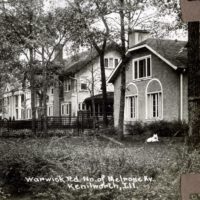
154 Warwick Lane, 1926


154 Warwick Lane, 1926
736 Roger, 1926
Our Kenilworth Centennial Homes, 1889-1925 exhibit is now online –
a captivating journey through a time of architectural growth and development of a residential community known for its exceptional construction standards.
Encounter the visionary minds who shaped these 300 centennial homes, including the acclaimed Franklin P. Burnham and the prolific George W. Maher. Each architectural style – from the ornate details of the Queen Anne to the clean lines of the Prairie School – reflects the aspirations and evolving lifestyles of a century past.
708 Kent, 1925
712 Kent, 1925
716 Kent, 1925
721 Kent, 1925
646 Kenilworth Terrace, 1925
544 Earlston, 1926
567 Earlston, 1926
602 Earlston, 1926
605 Earlston, 1925
614 Earlston, 1926
511 Brier, 1925
551 Brier, 1926
554 Brier, 1926
In 1905, George Maher designed 521 Roslyn Road for Francis and Nannie Lackner. Modeled after their parents’ home next door at 533 Roslyn Road, built just a year earlier, 521 Roslyn represents a subtle departure from Maher’s Prairie designs in favor of the Arts and Crafts style. Notable Arts and Crafts features include exposed roof beams that emphasize craftsmanship, restrained ornamentation, and an eclectic use of materials, such as the combination of brick and stucco on the exterior.
Similar Centennial Homes: 533 Roslyn Road (1904) and 338 Woodstock Ave (1908), both by George Maher.
Since its founding by Joseph Sears in 1889, Kenilworth has upheld a tradition of high-quality home construction, with many residences designed by renowned architects. Beyond its distinguished homes, the village showcases a variety of architectural styles, making it unique among similarly sized suburbs.
This engaging exhibit traces Kenilworth’s architectural evolution from the 1880s through the 1960s, illustrating how shifting architectural trends shaped the village’s transformation from farmland to a carefully planned suburban community. Through historic photographs, documents, and artifacts, A Well-Lived Home highlights the village’s rich architectural heritage and underscores the importance of its preservation.
Stop by the museum to experience the lasting legacy of Kenilworth’s built environment through Spring 2026.
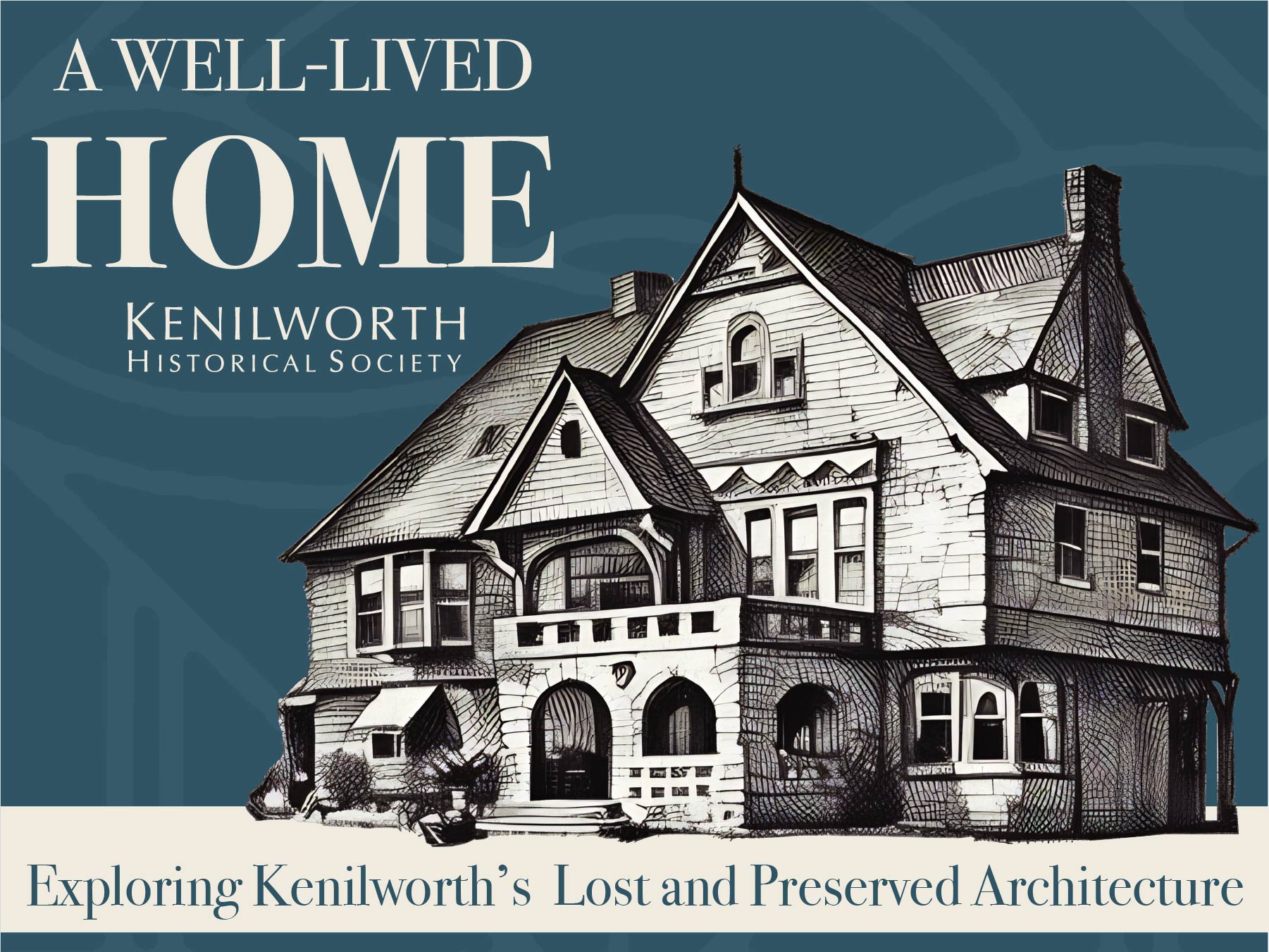
635 Wayland Avenue is the only home designed by George Maher in the western part of Kenilworth. Built in the Arts and Crafts style for Harry Lynn, this red brick bungalow originally had a jerkinhead roof above its front entrance. This type of roof combines a gable and a hipped roof. The jerkinhead roof has since been removed from the home. Located in the West Kenilworth subdivision, homes here were built from the 1890s through the 1950s.
Before the annexations of the 1920s, there were a handful of existing homes on the west side of Kenilworth. Most of these homes were not designed by trained architects. Along the southern portion of Ridge Road, there is a small concentration of homes from the late 19th century. 371 Ridge Road is an example of one of these homes. Notably, it is the only home in Kenilworth designed in the Italianate style, which was inspired by Italian farmhouses.
713 Maclean Avenue is an example of a smaller Colonial Revival style residence. The Brier Street subdivision contains many Colonial Revival and Tudor Revival homes. This subdivision was developed in the latter half of the 1920s through the 1950s. Designed by H. Bowen, 713 Maclean Avenue’s first homeowners were Orville and Mere Warwick.
132 Abingdon Avenue was built as a speculative house in the Tudor Revival style by A. L. Klewer. Tudor Revival homes are often made of brick or stone and are asymmetrical with steeply pitched roofs, decorative half-timbering, and quaint detailing. According to a 2008 survey, Tudor Revival is the second most prevalent architectural style in Kenilworth. 132 Abingdon Avenue is located in the Kenilworth Beach subdivision. Homes in this subdivision were largely constructed in the 1920s. The first homeowners were Jacques and Jeannette de La Chapelle.
235 Raleigh Road was built for Viola Jordan in the Colonial Revival style by Raymond Gregari. Beginning in the 1920s, Colonial Revival architecture gained considerable popularity. Many of Kenilworth’s Colonial Revivals from this period, such as this home, have a brick exterior, as opposed to clapboard siding. According to a 2008 survey, Colonial Revival is the most prevalent architectural style in Kenilworth. 235 Raleigh Road sits on the former site of the Kenilworth Golf Club, a nine-hole golf course located between Kenilworth Avenue, Oxford Road, Leicester Road, and Lake Michigan.
140 Kenilworth Avenue was built for Edward and Grace Marshall in the Italian Renaissance Revival style by E. N. Brancho. Italian Renaissance Revival homes are often symmetrical with either a hipped roof with ceramic tile or a flat roof. Windows and entryways are typically arched and adorned with pediments and other classical details. 140 Kenilworth Avenue is situated within the original acreage purchased by Joseph Sears. Homes in this area were still being constructed on empty lots into the 1920s.
Similar Centennial Homes: 307 Cumberland Avenue (1923), 210 Melrose Avenue (1923)
210 Melrose Avenue was built for George and Anna Benson in the Italian Renaissance Revival style by Charles Whitney Stevens. Italian Renaissance Revival homes are often symmetrical with either a hipped roof with ceramic tile or a flat roof. Windows and entryways are typically arched and adorned with pediments and other classical details. 210 Melrose Avenue is situated within the original acreage purchased by Joseph Sears. Homes in this area were still being constructed on empty lots into the 1920s.
Similar Centennial Homes: 307 Cumberland Avenue (1923) and 140 Kenilworth Avenue (1924)
141 Kenilworth Avenue is a Foursquare house built for Charles and Katheryn Ramsey. Foursquare houses have a simple, boxy design that features a square footprint with two stories and a hipped roof. The efficient layout and straightforward design of Foursquares made them a practical and affordable housing option for middle-class families. Notably, modernist architect Harry Weese lived at 141 Kenilworth Avenue as a child and adolescent in the 1920s. In 2009, the home was listed on the National Register of Historic Places.
Similar Centennial Homes: 416 Cumnor Road (1907) and 520 Abbotsford Road (1908)
201 Cumberland Avenue was designed by William Dinwiddie for Ralph and Lucy Starrett. Ralph Starrett was the brother of famous American builders Paul and William Starrett. 201 Cumberland Avenue is an example of the Arts and Crafts style. Arts and Crafts homes emphasize simple designs and craftsmanship. They typically have gabled roofs that are low-pitched, overhanging eaves, and exposed structural elements. These homes feature a variety of surface materials and often have porches or verandas.
Similar Centennial Homes: 320 Melrose Avenue (1907) by George Maher and 528 Warwick Road (c. 1906)
In 1904, George Maher designed 533 Roslyn Road for Franklin and Meta Corbin. Meta Corbin’s parents, Francis and Nannie Lackner, liked the home so much that they hired George Maher to design a similar home next door at 521 Roslyn Road in 1905. Built in the Arts and Crafts style, both homes have dramatic gables, entryway pergolas, and extended second story bay windows with balconies.
424 Warwick Road was George Maher’s own home that he designed when he was 29 years of age. The home blends various architectural styles, including Victorian and Arts and Crafts. The motif in 424 Warwick Road is the diamond pattern, found in the individual windowpanes, in the front porch window, and in the roof shingles. In 1979, the home was listed on the National Register of Historic Places.
George Maher (1864-1926) and his wife, Elizabeth Brooks Maher (1866-1963), were very active members of the community. Their only child, Philip Brooks Maher (1894-1981), was also an architect. He designed a few homes in Kenilworth, as well as the Stuart Memorial Building in 1972. 424 Warwick Road remained in the Maher family until the 1980s.
329 Warwick Road was built for Benjamin and Gertrude Odell by George Maher in 1912. Benjamin Odell was an attorney. The Prairie-style residence is a symmetrical block constructed of red brick with a horizontal grouping of windows on the second floor. The home also has horizontal striations or streaks in its roof, a feature of Maher’s work that have been removed from many homes except this one. In 1914, famed Chicago landscape architect Jens Jensen was hired to complete a design for the home. Jensen completed several landscape designs in Kenilworth, most notably Mahoney Park in 1933.
305 Kenilworth Avenue was built for Frank and Lillian Ely by George Maher in 1910. Unlike other Prairie-style structures, 305 Kenilworth Avenue has a cubic shape that can also be found in other Maher designs in Kenilworth. This blocky form first appeared in Maher’s work in his famed John Farson House in Oak Park, Illinois.
305 Kenilworth Avenue serves as a notable example of Maher’s “motif-rhythm theory”, wherein a symbol, often a plant or geometric design, is chosen as a decorative element incorporated throughout the residence. There are two motifs present in 305 Kenilworth Avenue: first, the partially flattened arch, which can be found in the column capitals of the porch, in the door frame, and in the hood over the second-floor window; and, second: the sloping form, seen in the overall shape of the house and in the porch columns.
Similar Centennial Homes: 336 Essex Road (1896), 322 Woodstock Avenue (1900), and 307 Melrose Avenue (1910), all by George Maher.
205 Essex Road is Kenilworth’s only residence designed by Frank Lloyd Wright. Built for Hiram and Agnes Baldwin, the home fully embodies the Prairie style. 205 Essex Road has a strong horizontal emphasis with its low-pitched hipped roof, flat overhanging eaves, exterior wood stripping, and bands of casement windows. One signature Wright feature showcased in the home is the concealed entrance. In 1983, the home was listed on the National Register of Historic Places.
Similar Centennial Homes: 240 Essex Road (1911) by Tallmadge and Watson and 304 Melrose Avenue by George Maher (c. 1914)
255 Melrose Avenue was built for Edgar and Katherine Barratt in 1896. Edgar Barratt was a civil engineer. Designed by George Maher, 255 Melrose Avenue is considered one of Maher’s transitional buildings. It combines Queen Anne elements, present in the rubblestone base and chimneys, semi-circular tower, and asymmetrical facade with features of the emerging Prairie Style, such as the broad hipped roof, wide eaves, and rectangular building shape.
333 Ivy Court is an example of a Dutch Colonial Revival home. In 1891, Franklin Burnham designed three modest homes on Ivy Court for contractors of the Kenilworth Company. 333 Ivy Court is the only one surviving. The home was built for George and Angela Kruse. Mr. Kruse was a builder who helped construct many structures in the village. Prior to working for the Kenilworth Company, Kruse worked as a tenant farmer in Kenilworth. During that time, he and his wife lived in a cottage at 329 Sheridan Road that was razed in 2013.
314 Abbotsford Road was designed by George Maher for Morton and Clara Gould. The home contains a gambrel roof, a distinctive feature of the Dutch Colonial Revival style. A gambrel roof has two slopes on each side, with the lower slope having a steeper pitch than the upper slope. Notably, the facade of this home features a gambrel-shaped gable. Other characteristics of the Dutch Colonial Revival style include a symmetrical design, dormer windows, shutters, and a front porch or portico.
Similar Centennial Homes: 336 Abbotsford Road (1891) by George Maher and 415 Cumnor Road (c. 1908)
Designed in the Colonial Revival style, 333 Cumnor Road was built for a family that never moved in. The home’s subsequent owners were Homer and Isadore Taylor. In 1895, a meeting at 333 Cumnor led to the development of a woman’s club, the Neighbors of Kenilworth, with Isadore Taylor serving as its first president. Homer Taylor was a skilled archer who competed in the 1904 Summer Olympics.
241 Melrose Avenue was built for Alfred and Margaret Martin in the Colonial Revival architectural style by an unknown architect. Colonial Revival architecture takes many different forms. Typical features include a rectangular shape, a symmetrical facade, gable roofs (often with dormers), and shingles or clapboard siding. Sometimes classical details, such as columns, are incorporated into the design. Some late 19th century Colonial Revivals, such as this home, exhibit asymmetry and varied rooflines, representing the influence of the then-popular Queen Anne style.
Similar Centennial Homes: 42 Kenilworth Ave (1892), 431 Essex Road (1895), 523 Essex Road (c. 1900)
519 Warwick Road was designed by Paul Starrett in the Classical Revival style for his family, although they relocated before the home was constructed. Paul Starrett was a famous American builder, whose firm was responsible for the construction of the Empire State Building and the Lincoln Memorial, among other notable commissions. This was the first home built north of Melrose Avenue in Kenilworth. To early residents, the undeveloped area between Winnetka Avenue and Melrose Avenue was known as the North Woods.
220 Melrose Avenue was designed by Franklin Burnham in the Queen Anne style. The home is a unique example of a Queen Anne with the half-timbering on the second and third floors. 220 Melrose Avenue was the home of James and Nora Culbertson. James Culbertson was a lumber executive who was active in the civic life of early Kenilworth. He served as the first village president and contributed generously to the construction of the Kenilworth Assembly Hall in 1906 and an addition to the Kenilworth Union Church in 1909.
417 Warwick Road was built for Samuel and Abigail Barry, the parents-in-laws of Joseph Sears. The home was designed by Franklin Burnham in the Classical Revival style. Following Joseph Sears’ death in 1912, Helen Sears and some of their children moved into 417 Warwick Road. The home remained in the Sears family through the 1940s. Since the 1980s, the home has been owned by the Kenilworth Union Church. In 2022, the Kenilworth Union Church announced plans to raze the structure as part of a larger facility renovation project.
Similar Centennial Homes: 149 Kenilworth Avenue (c. 1895), 219 Sheridan Road (c. 1913)
37 Kenilworth Avenue was the third home built in Kenilworth. Franklin Burnham designed the home for himself and his wife, Adelia Burnham. Like the first two homes built in the village, 37 Kenilworth Avenue is an example of the Queen Anne style. Before joining the Kenilworth Company, Franklin Burnham was an accomplished architect. His firm, Edbrooke and Burnham, a partnership with architect Willoughby J. Edbrooke, completed numerous commissions, including the 1889 Georgia State Capitol.
339 Kenilworth Avenue was the second home built in Kenilworth. The home was built for Charles and Emma Smith. Dr. Charles Smith was the secretary of the Kenilworth Company, who oversaw sales. He also hosted prospective buyers in this home. His handwriting forms the script of the “Kenilworth” logo as seen on the Kenilworth train station sign. Franklin Burnham designed 339 Kenilworth Avenue in the Queen Anne style.
354 Kenilworth Avenue was the first home built in Kenilworth. The home was designed by Franklin Burnham for William H. H. and Kate Sears. William H. H. Sears was the treasurer of the Kenilworth Company and the half-brother of Joseph Sears. In 1893, at just twelve years old, William and Kate’s son, John Sears, founded a weekly newspaper, The Kenilworth News. The publication chronicled daily life in early Kenilworth. Copies of the newspaper are available in the permanent exhibit. At its base, 354 Kenilworth Avenue incorporates rusticated stonework, an architectural detail also found in other Queen Anne style residences designed by Franklin Burnham.
321 Melrose Avenue was built for Ullman and Jennie Strong by an unknown architect. This home is an excellent example of the Queen Anne style. Queen Anne homes are characterized by their asymmetrical design, elaborate ornamentation, and use of a variety of surface materials and window configurations. They often feature steeply pitched roofs, dominant front gables, wrap-around porches, and towers or turrets. These homes sometimes have vibrant exterior colors.
Similar Centennial Homes: 158 Melrose Avenue (1892) by Joseph Lyman Silsbee, 322 Kenilworth Avenue (1893), 514 Essex Road (1897) by Franklin Burnham
326 Essex Road was built for Frank and Harriet Elizabeth Root in 1896. Frank Root was a music publisher whose brother, Walter Root, also lived in Kenilworth. In 1900, A. Shreeve Badger, a lumber merchant, and Sarah Frances Cowles Badger moved into the residence. The Badgers kept horses and a donkey on the property. In 1992, the home was listed on the National Register of Historic Places.
326 Essex Road was designed in the Classical Revival style, which gained popularity following its prominent use in the White City of the 1893 World’s Columbian Exposition. Inspired by classical Greek and Roman architecture, Classical Revival homes feature symmetrical facades with a central entrance and low-pitched or flat roofs. The entryway often includes a pediment, portico, or a porch. The homes are adorned with columns, pilasters, balustrades, and other classical detailing.
The Kenilworth Historical Society holds original architectural drawings of the house, which include an inscription at the bottom that reads: “The Franklin Burnham Co. Architects, Chicago, ILL.” Although a few secondary sources attribute the design to Daniel Burnham, the renowned Chicago architect, it is more likely that Franklin Burnham was the actual architect of the home. The two are of no relation.
Similar Centennial Home: 236 Cumnor Road (c. 1905)
100 Woodstock, 1926
145 Woodstock, 1921
157 Woodstock, 1924
206 Woodstock, 1925
220 Woodstock, 1924
221 Woodstock, 1924
240 Woodstock, 1915
256 Woodstock, 1911
306 Woodstock, 1920
307 Woodstock, 1910
322 Woodstock, 1900
338 Woodstock, 1908
344 Woodstock, pre-1920
416 Woodstock, 1909
422 Woodstock, 1909
430 Woodstock, pre-1920
206 Winnetka, 1923
606 Wayland, 1923
618 Wayland, 1926
626 Wayland, 1922
635 Wayland, 1924
200 Warwick Road, 1921
211 Warwick Road, 1925
212 Warwick Road, 1925
221 Warwick Road, 1921
226 Warwick Road, 1915
234 Warwick Road, 1915
235 Warwick Road, 1913
243 Warwick Road, 1922
321 Warwick Road, 1921
322 Warwick Road, 1913
328 Warwick Road, 1915
329 Warwick Road, 1912
333 Warwick Road, 1925
336 Warwick Road, 1909
417 Warwick Road, 1892
424 Warwick Road, 1893
432 Warwick Road, 1893
515 Warwick Road, 1910
519 Warwick Road, 1896
520 Warwick Road, 1908
527 Warwick Road, 1912
528 Warwick Road, 1906
612 Warwick Road, 1909
615 Warwick Road, 1925
621 Warwick Road, 1922
626 Warwick Road, 1926
546 Sterling, 1920
554 Sterling, pre-1920
558 Sterling, pre-1920
736 Sterling, 1926
201 Sheridan, 1917
212 Sheridan, 1912
219 Sheridan, c. 1913
220 Sheridan, 1908
224 Sheridan, 1919
227 Sheridan, 1924
234 Sheridan, 1921
245 Sheridan, 1920
430 Sheridan, 1918
521 Roslyn, c. 1900
533 Roslyn, 1904
536 Roslyn, c. 1910
547 Roslyn, 1910
610 Roger, pre-1920
616 Roger, 1920
620 Roger, 1922
624 Roger, 1921
75 Robsart, 1925
78 Robsart, 1925
84 Robsart, 1923
85 Robsart, 1925
88 Robsart, 1924
89 Robsart, 1926
92 Robsart, 1926
93 Robsart, 1923
98 Robsart, 1923
99 Robsart, 1925
106 Robsart, 1926
107 Robsart, 1926
111 Robsart, 1925
115 Robsart, 1925
116 Robsart, 1926
120 Robsart, 1926
124 Robsart, 1923
127 Robsart, 1923
141 Robsart, 1926
147 Robsart, 1924
152 Robsart, 1926
153 Robsart, 1922
157 Robsart, 1925
307 Ridge, pre-1920
311 Ridge, pre-1920
315 Ridge, pre-1920
333/335 Ridge, pre-1920
365 Ridge, pre-1920
371 Ridge, pre-1920
505 Ridge, 1926
310 Richmond, c. 1910
315 Richmond, 1925
316 Richmond, 1925
333 Richmond, 1923
212 Raleigh, 1922
227 Raleigh, 1925
228 Raleigh, 1923
234 Raleigh, 1921
235 Raleigh, 1923
320 Raleigh, 1924
328 Raleigh, 1921
336 Raleigh, 1920
337 Raleigh, 1925
529 Park, pre-1920
535 Park, pre-1920
619 Park, pre-1920
627 Park, pre-1920
640 Park, 1925
118 Oxford, 1922
126 Oxford, 1923
140 Oxford, 1921
156 Oxford, 1920
200 Oxford, 1920
205 Oxford, 1925
208 Oxford, 1922
222 Oxford, 1921
230 Oxford, c. 1920
236 Oxford, 1923
244 Oxford, 1923
250 Oxford, 1921
266 Oxford, 1913
270 Oxford, 1915
306 Oxford, 1911
310 Oxford, c. 1910
314 Oxford, 1909
318 Oxford, 1908
320 Oxford, c. 1911
325 Oxford, 1914
326 Oxford, c. 1910
330 Oxford, c. 1905
122 Melrose, 1923
135 Melrose, 1922
145 Melrose, c. 1910
155 Melrose, 1923
158 Melrose, 1892
205 Melrose, 1925
210 Melrose, 1923
220 Melrose, 1893
223 Melrose, 1914
240 Melrose, 1923
241 Melrose, 1892
255 Melrose, 1896
258 Melrose, 1895
304 Melrose, c. 1914
307 Melrose, 1910
320 Melrose, 1907
321 Melrose, 1896
337 Melrose, 1894
338 Melrose, 1915
522 Melrose, pre-1920
526 Melrose, pre-1920
531 Melrose, pre-1921
534 Melrose, pre-1920
538 Melrose, pre-1920
539 Melrose, pre-1920
547 Melrose, pre-1920
550 Melrose, 1921
551 Melrose, 1922
557 Melrose, 1922
601 Melrose, pre-1920
611 Melrose, pre-1920
622 Melrose, 1923
623 Melrose, pre-1920
635 Melrose, pre-1920
713 Maclean, c. 1922
219 Leicester, 1925
222 Leicester, 1921
228 Leicester, 1921
235 Leicester, 1908
240 Leicester, 1923
312 Leicester, 1908
315 Leicester, 1920
320 Leicester, 1893
321 Leicester, 1926
327 Leicester, 1921
328 Leicester, 1895
333 Leicester, 1925
336 Leicester, 1917
36 Kenilworth, 1895
37 Kenilworth, 1891
42 Kenilworth, 1892
43 Kenilworth, 1893
122 Kenilworth, 1925
123 Kenilworth, 1926
140 Kenilworth, 1924
141 Kenilworth, 1908
149 Kenilworth, 1895
157 Kenilworth, 1908
165 Kenilworth, 1896
256 Kenilworth, 1909
257 Kenilworth, 1914
305 Kenilworth, 1908
306 Kenilworth, 1909
322 Kenilworth, 1893
323 Kenilworth, 1892
339 Kenilworth, 1891
354 Kenilworth, 1891
333 Ivy, 1891
336 Ivy, 1891
615 Ivy, 1911
621 Ivy, c. 1905
633 Ivy, 1919
639 Ivy, 1914
530 Exmoor, 1922
536 Exmoor, pre-1920
538 Exmoor, pre-1920
541 Exmoor, pre-1920
544 Exmoor, pre-1920
549 Exmoor, 1921
552 Exmoor, pre-1920
625 Exmoor, pre-1920
631 Exmoor, 1921
638 Exmoor, 1921
650 Exmoor, 1921
205 Essex, 1905
211 Essex, 1924
226 Essex, 1926
236 Essex, 1925
239 Essex, 1905
240 Essex, 1911
312 Essex, 1899
319 Essex, 1909
326 Essex, 1893
331 Essex, 1905
336 Essex, 1895
337 Essex, 1900
423 Essex, 1893
430 Essex, 1908
431 Essex, 1895
514 Essex, 1897
515 Essex, 1895
522 Essex, 1904
523 Essex, 1905
545 Essex, 1922
605 Essex, 1921
610 Essex, 1922
614 Essex, 1921
615 Essex, 1924
236 Cumnor, c. 1905
237 Cumnor, pre-1922
244 Cumnor, 1910
245 Cumnor, 1909
249 Cumnor, c. 1905
303 Cumnor, 1891
304 Cumnor, c. 1910
310 Cumnor, 1893
316 Cumnor, 1892
323 Cumnor, 1908
324 Cumnor, c. 1910
327 Cumnor, 1914
330 Cumnor, 1891
331 Cumnor, 1914
333 Cumnor, 1893
412 Cumnor, c. 1900
415 Cumnor, c. 1908
416 Cumnor, c. 1903
417 Cumnor, 1893
422 Cumnor, 1893
428 Cumnor, c. 1909
517 Cumnor, 1910
523 Cumnor, 1910
201 Cumberland, 1906
206 Cumberland, 1906
207 Cumberland, 1908
222 Cumberland, 1909
241 Cumberland, 1926
306 Cumberland, 1923
307 Cumberland, 1923
320 Cumberland, 1925
733 Cumberland, 1926
Stop by and support KHS by purchasing any of these available items – while learning more about Kenilworth
Kenilworth: the Suburban Ideal (DVD or Blu-ray) – $10
Kenilworth Historical
Society, 2016
George Washington Maher in Kenilworth (Guidebook) – $10
Kenilworth
Historical Society, 1993
Joseph Sears and His Kenilworth – $15
Colleen
Kilner, 1969
Kenilworth First Fifty Years (Reprint) – $15
Village
of Kenilworth, 1947
Kenilworth Stories by Ginny Anderson – $25
Kenilworth
Historical Society, 2024
Kenilworth Tree Stories – $15
Colleen
Kilner, 1972
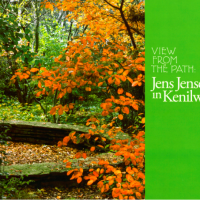
View from the Path: Jens Jensen in Kenilworth – $15
Kenilworth
Historical Society, 2004
Deep Dive Exhibit Beach Towels – $35
Centennial Home Plaque – $100
Kenilworth Flag – $65
Kenilworth Fountain Pickard China Plate – $10
Scenes of the Village of Kenilworth Notecards – $15
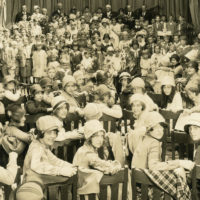
Women in cloche hats seated at a Kenilworth Union Church Sunday School Class, 1921.

In the aftermath of World War I, the entire world was shaken and underwent many changes socially, politically, and technologically. Kenilworth was no exception. In this exhibit we explored those changes within Kenilworth and highlighted the fashion, lifestyle, and community during the decade.
In this era we saw the prohibition of alcohol, increase in global wealth and organized crime, Flapper fashion, the Charleston, Jazz, and women finally getting the rights of citizenship. This was the decade of extravagance, opulence, and independence which gave rise to styles like Art Deco and clothing that reflected these new social freedoms.
The exhibit was on display from March 2020 to March 2023.
2018.xx.27.9-.12
During World War I, the United States Treasury issued securities termed “Liberty Bonds” (or “Liberty Loans”) to help fund the Allied cause. War bonds allowed the government to borrow money to finance its war efforts. There were four issues of Liberty Bonds in April and October 1917, and in April and September 1918. The first Liberty Bonds were issued three weeks after the United States Congress officially declared war on April 6, 1917. In April 1919, a fifth bond, the Victory Liberty Loan, was released after the Armistice ended fighting between the Allies and Germany in November 1918.
The 13 Liberty Bond buttons in our collections are a testament to the government’s campaign to popularize the bonds. The response to the first Liberty Bond was underwhelming, resulting in the release of the second Liberty Bond just five months later. While the Liberty Bonds did sell out, it was done below par, or face value. The Liberty Bonds campaign enlisted the help of artists to create posters and celebrities to host bond rallies. Investment in the Liberty Bonds became a symbol of patriotic duty.
The buttons were donated by the Haneman family of Kenilworth.
In the aftermath of the First World War, the entire world was shaken and underwent a lot of changes socially, politically, and technologically. Kenilworth was no exception. In this exhibit we look at those changes within Kenilworth and highlight the fashion, lifestyle, and community during the decade.
In this era we saw the prohibition of alcohol, increase in global wealth and organized crime, Flapper fashion, the Charleston, Jazz, and women finally getting the rights of citizenship. This was the decade of extravagance, opulence, and independence which gave rise to styles like Art Deco and clothing that reflected these new social freedoms. In Kenilworth, these changes in society were very prominent. Going to the Assembly Hall on any given weekend was guaranteed to be a good time with dances, jazz performances, and plays happening on a regular basis. Rumors of speakeasies and illegal alcohol distributors were rampant in Chicago and the entire North Shore. The ‘20s also saw the expansion of Kenilworth with the annexation to the west and the acquisition of Mahoney Farm, which opened up more property lots and what is now known as Mahoney Park Wildflower and Bird Sanctuary.
Visit the new exhibit to explore the past, the changes that came to Kenilworth, and see the opulence that was life in the village during the 1920s.
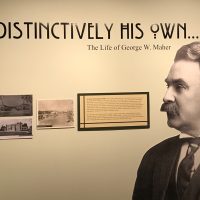
Distinctly His Own: The Life of George W. Maher was displayed from September 2018 – February 2020
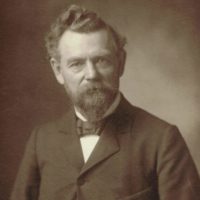
Born on Christmas 1864 in West Virginia, George Maher grew up along the banks of the Ohio River in New Albany, Indiana. He made his way to Chicago and found work in the architectural offices of Joseph Lyman Silsbee. While there his ideas on architecture developed alongside fellow draftsman, Frank Lloyd Wright. As a contemporary of Wright, Maher would go on to make his own significant contributions to Prairie School architecture across the United States.
He made his home in Kenilworth. Not just in the house he built for his family, but also in the community he helped build around it. During his lifetime he designed and built some 40 structures in Kenilworth and many more that can still be seen across Chicago and its suburbs.
Yet for all the architectural achievements he is known for, discovering George Maher the individual is the focus of our new exhibit. He was a man who surrounded himself with friends and family and found joy in automobiles and agricultural projects. He was also a man who suffered from severe mental issues that ultimately brought an early end to his life and work.

Distinctly His Own: The Life of George W. Maher was displayed from September 2018 – February 2020
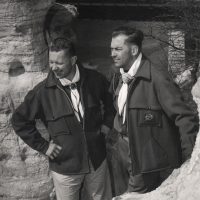
Artie Bergman Jr. and Charlie Barnes, c. 1970, KHS
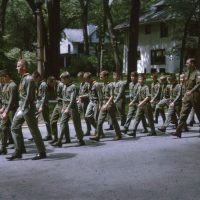
The exhibit explores the three different eras that defined Troop 13 throughout its long and rich history. Prior to the establishment of the Boy Scouts, there was the Kenilworth Cadets, which similarly acted as an organization for boys to learn skills like camping and self-discipline, but also military drills.
The first era of Scouting in Kenilworth, known as the Townley Era, saw more than just the development of Troop 13, it also shaped and strengthened the morals, principles, and sense of camaraderie held by the boys of the village. Troop 13 in Kenilworth was formed in 1919 under its first scoutmaster Carl Keith. It was Carl’s son and scout, Elbridge, who wrote to the National Scout Headquarters in New York City to officially establish the Scout Troop in Kenilworth. Carl Keith only served as scoutmaster for two years until he was succeeded by Roy Jarrett and later Bob Townley in 1922 who would remain scoutmaster for the next 33 years, inspiring generations of Kenilworth’s youth.
The second era primarily led by two scoutmasters, Artie Bergman and Charlie Barnes, both were scouts under Townley and eventually assistant scoutmasters as well. During their era Troop 13 saw even more growth, with the development of the Explorers and Cub scouts. More community oriented projects and fundraisers, including the popular annual Pancake Breakfast event.
The third, Current Era, has been led by the mentees of Artie and Charlie and have had many reasons to celebrate as the honors of Troop 13 continue to grow, the 100th anniversary being least among the great things Troop 13 scouts and scout leaders continue to do for their community.
The Boy Scouts Exhibit was displayed from May 2019 – November 2019
Gallery showing exhibit on Marion Mahony Griffin, c. 2018, KHS
This exhibit shares the intriguing story of architect, artist, and naturalist Marion Mahony Griffin. Born in 1871, mere months before the Great Chicago Fire, Marion grew up with her family in Winnetka before returning to Chicago in 1879. She became only the second woman to graduate from MIT with a degree in architecture and was the first woman registered to practice architecture in Illinois at a time when the glass ceiling for women was suffocatingly low.

Model designed by Marion Mahony Griffin, Courtesy of Paul Kruty, KHS
As a designer in Frank Lloyd Wright’s studio Marion had an essential role in the majority of the drawings in the 1910 German publication that brought Wright international recognition. While working for Wright, Marion met her husband and architectural partner, Walter Burley Griffin. They left Wright’s studio to pursue a project creating Australia’s new capital, Canberra. From there they made a significant impact creating a model suburb outside of Sydney, along with numerous other projects around Australia and India. Marion returned to Chicago following Walter’s death in 1937, where she settled in Roger’s Park with her sister’s family until her death in 1961. The exhibit illustrates her incredible life through text, images, scale models of her work, original artwork, and scholar interviews.
In Her Own Right: Marion Mahony Griffin was displayed from May-July 2018
How Can I Help You: Business in Kenilworth was displayed from May-November 2017
The Kenilworth Company, Blann Pharmacy, the original Kenilworth Store, The North Shore Line, The Chicago & North Western Railroad, as well as a brief history of planning and zoning were all highlighted within the exhibition. The exhibition extended through to the main streets of Kenilworth. Window clings were posted in twelve shop windows along Green Bay Road and Park Drive. Each cling contained historical photographs and information specific to the address and business where it was posted.

This exhibit was generously sponsored by:

How Can I Help You: Business in Kenilworth was displayed from May-November 2017
American Toby Jug Museum
The American Toby Jug Museum houses over 8,000 Toby and Character jugs in ninety-seven cabinets, and is the largest collection of its kind in the world. The Museum is open to persons of all ages, from school groups to seniors, as well as individuals interested in seeing the collection. Museum experts also offer free lectures on the subject. For more information, call 1-877-TOBYMUS (877-862-9687).
The Baha’i House of Worship
The Baha’i House of Worship is open to the public every day of the year. It is located at 100 Linden Ave in Wilmette, IL, a few miles north of Chicago. Parking is available on-site. The Linden Station on the CTA Purple Line is a few blocks away.
The Block Museum of Art
The Block is a dynamic, imaginative, and innovative teaching and learning resource for Northwestern and its surrounding communities, featuring a global exhibition program that crosses time periods and cultures and serves as a springboard for thought-provoking discussions relevant to our lives today.
Chicago Botanic Garden
The Chicago Botanic Garden opened more than 45 years ago as a beautiful place to visit, and it has matured into one of the world’s great living museums and conservation science centers. Every year, more than one million people visit the Garden’s 27 gardens and four natural areas, uniquely situated on 385 acres on and around nine islands, with six miles of lake shoreline. The Garden also has a renowned Bonsai Collection. Classes for all ages are offered, see their calendar for details.
Dave’s Down to Earth Rock Shop
Dave and Sandy continue to travel and collect both for the museum and shop to this day. It’s a wonderfully unique place to visit for both young and old, amateur and expert. With such an amazing variety of fossils, rocks, crystals and more, it’s a great place to learn about, or just enjoy, the beauty of some of the most amazing treasures the Earth holds. Truly one of the hidden gems of the Chicago area!
Elgin History Museum
The Elgin History Museum is housed in an 1856 landmark building known as Old Main that was once part of the Elgin Academy campus. We are located at 360 Park Street just outside of historic downtown Elgin, IL. We are open Wednesday through Saturday from 11am until 4pm.
Elgin Public Museum
Built in 1907, the Elgin Public Museum is the only natural history museum in the Fox Valley area. The Museum offers exhibits and educational programs with natural history and cultural themes for families, school groups, Scouts, clubs, organizations, homeschoolers and anyone who wants to have fun while learning!
Evanston History Center
The Evanston History Center, located in the historic Charles Gates Dawes House, strives to capture and teach Evanston’s rich history. If you live in the area or plan to visit and are interested in Evanston’s past, please visit us.
Frances Willard House Museum
The Center for Women’s History and Leadership is a 501(c)3 non-profit organization that manages the Frances Willard House Museum, and the Frances Willard Memorial Library and Archives. Our mission is to inspire and encourage everyone to exercise civic leadership as Frances Willard’s lasting legacy.
Glencoe Historical Society
Founded in 1937, the Glencoe Historical Society is devoted to the collection, protection and preservation of items related to the Village of Glencoe, its residents and its institutions. In addition to presenting award winning exhibits at the Eklund Museum campus located at 375 Park Avenue, we also sponsor programs and events for residents and visitors both individually and in cooperation with various community partners including the Village of Glencoe, the Glencoe Public Library, the Glencoe Park District, the Glencoe public schools, Family Service of Glencoe and others.
Glenview Park District
The Glenview Park District is one of the largest, most unique park districts in Illinois! Whether you are interested in learning about the future, discovering the past, taking up a new sport, enjoying your leisure time in the great outdoors…or just plain having fun…the Glenview Park District is the place for you.
Grayslake Heritage Center & Museum
The Grayslake Heritage Center & Museum is a partnership between the Village of Grayslake and the Grayslake Historical Society. To foster good communication and provide strong guidance, the partners created the Heritage Center Advisory Committee, with representatives from the Village of Grayslake Board of Trustees and the Grayslake Historical Society providing input and advice on future exhibitions, programs and initiatives.
Hamlin Time & Glass Museum
One suburban man and his family are passionate about time and starting next week they want you to make time to see their personally curated collection. There are so many pieces they decided to build a museum to house and display them. It’s called the Halim Time and Glass Museum. It’s located in Evanston and houses over 1100 time pieces and over 70 stained glass pieces of art. The building is five stories tall and is filled with history, art and the study of time.
Highland Park Historical Society
The mission of the Highland Park Historical Society is to preserve our community’s past, to inspire an appreciation of our history and culture and share with the community and scholars the rich history of Highland Park, Illinois.
History Center Lake Forest-Lake Bluff
The History Center of Lake Forest-Lake Bluff has been home to the stories of our community for more than 45 years. And now we have a state-of-the-art history museum that is the pride of Lake Forest and Lake Bluff. Our new home—your home for history—is a gathering place where the community can come together to celebrate who we are and how we are connected.
Hoosier Grove Museum
For local history buffs, the Hoosier Grove Schoolhouse Museum is open from 11:00 am to 4:00 pm on Wednesdays, 9:00 am to 11:30 am on Saturdays. Costumed volunteers such as Curtis and her daughter, Cindy, who both live in Streamwood, are on hand to answer visitors’ questions.
I Love North Shore History
I Love North Shore History is a Facebook group for people who love history about the northern suburbs of Chicago. Group members and local history organizations are encouraged to share information about local history as well as current historical events, exhibits, and other information. Please visit this group often and share it with your friends! And please note that I Love North Shore History is for people who love learning about and discussing the deep history of our communities. Be respectful if you comment and understand that no nastiness is allowed here!
Illinois Holocaust Museum & Education Center
The mission of the Illinois Holocaust Museum and Education Center is expressed in our founding principle: Remember the Past, Transform the Future. The Museum is dedicated to preserving the legacy of the Holocaust by honoring the memories of those who were lost and by teaching universal lessons that combat hatred, prejudice and indifference. The Museum fulfills its mission through the exhibition, preservation and interpretation of its collections and through education programs and initiatives that foster the promotion of human rights and the elimination of genocide.
Kohls Children’s Museum
Kohl Children’s Museum of Greater Chicago was founded in 1985 as an extension of the Kohl Teaching Center in Wilmette, one of four such centers in Illinois and Israel conceived by Dolores Kohl in 1972 and supported by the Dolores Kohl Education Foundation. Offering creative methods of enhancing traditional approaches to teaching, Kohl Teaching Centers provided training and educational resources to teachers and helped them incorporate hands-on experiences into their classrooms. Kohl Children’s Museum was founded to continue reaching educators and extend its service to meet the growing needs of families and the community at large through interactive exhibits and hands-on programs.
Lake Bluff History Museum
The Lake Bluff History Museum is a volunteer 501(c)(3) non-profit organization. Our mission is to keep Lake Bluff History alive by researching and preserving historical information, creating interest in and sharing knowledge of local history, inspiring broad participation in events supporting this mission and embodying the spirit and pride characteristic of Lake Bluff.
Mitchell Museum of the American Indian
The Mitchell Museum of the American Indian is one of only a handful of museums across the country that focuses exclusively on the art, history, and culture of Native American and First Nation peoples from throughout the United States and Canada. It promotes public understanding of cultural diversity through first voice perspectives.
Northbrook Historical Society
The Northbrook Historical Society was organized in December 1973 and Incorporated in March 1974 by residents interested in preserving the history of our Village. As stated in the bylaws, the purpose of the society is: To discover, collect, preserve and disseminate knowledge that establishes or illustrates the history of the Village of Northbrook, its exploration, settlement, development and progress.
Skokie Heritage Museum
…takes pride in its ability to serve the more than 63,000 residents of Skokie, Illinois and its customers throughout Chicagoland. Whether protecting natural resources, preserving historical sites or providing thousands of unique recreational opportunities within its more than 240 acres of parkland, the district has offered a multitude of quality programs since 1928.
St. Charles History Museum
The St. Charles History Museum is a 501©3, non-profit organization operating the St. Charles History Museum and historic archive. The Museum holds more than 10,000 photographs in its archive and 15,000 artifacts in its collection.
Wheeling Historical Society & Museum
The Wheeling (Illinois) Historical Society and Museum celebrates the link between the past and the present. The museum is a cooperative effort of the Village of Wheeling, Wheeling Park District, Indian Trails Public Library and Wheeling Historical Museum.
Wilmette Historical Museum
The Wilmette Historical Museum was established by the Village of Wilmette in 1951. Today, it is jointly operated by the Village of Wilmette and by the Wilmette Historical Society, a non-profit, volunteer-run organization devoted to promoting local history. The Museum’s collections, begun in 1950, are now quite extensive.
Winnetka History Museum
WHS owns and operates two historic buildings in Winnetka. Our Museum and headquarters at 411 Linden Street houses exhibit and gallery space and is open for research, including the reference library, photograph collections, museum collections, archives, and house files. The Schmidt-Burnham Log House seasonally offers visitors a glimpse of life in the 1850s through the interpretation of costumed docents.
Community House Winnetka
The Community House Winnetka is a unique nonprofit organization on Chicago’s North Shore that has played a special role in the community for more than a century. Founded in 1911, the mission of Community House is to enrich the lives of North Shore residents, their families, and friends by providing educational, cultural, social and recreational opportunities for people of all ages.
The Joseph Sears School
Located in the village of Kenilworth, The Joseph Sears School combines the feel and traditions of a small-town community with the forward-thinking practices of a 21st-century educational institution. Our goal is to prepare students for success through their teenage years and beyond by allowing them to cultivate their passions, develop a genuine love of learning and establish a system of values that will guide them throughout their later stages of life.
Kenilworth Assembly Hall
The Kenilworth Club Assembly Hall, designed by architect George W. Maher, is listed in the National Register of Historic Places and has served as Kenilworth’s community house since its construction in 1906-1907. When The Kenilworth Club and Assembly Hall was built in 1906, it symbolized a better way of living in the century to come. Today, more than 100 years later, a second generation of community leaders is preserving and protecting the vision that gave birth to Kenilworth, and the club that made it legendary. Take a moment to read about the fascinating history and importance of the Kenilworth Club in the premier issue of “Quintessential New Trier”, the new magazine serving the north shore.
The Kenilworth Club
Since 1891 the mission of The Kenilworth Club has been to foster civic and social activities for the residents of Kenilworth. For over 120 years The Kenilworth Club has been the village hub for connecting Kenilworthians and has been the steward of some of the community’s longest standing traditions.
Kenilworth Cookbook Club
The Kenilworth Cookbook Club is a group of women in the community that gather once a month to create a dish from a featured cookbook. Each month, we are invited into a neighbor’s home to feast and promote camaraderie among the community.
The Kenilworth Garden Club
Kenilworth Garden Club is a charitable organization founded over one-hundred years ago in Kenilworth, Illinois. We have a long history of benefiting and educating our community in the areas of floral arts, horticulture, conservation, civic improvement, education, photography, garden history, landscape architecture and design.
Kenilworth Park District
The Kenilworth Park District preserves and enhances our parks and facilities and provides recreational opportunities, and events that cultivate a stronger community.
Lake Forest – Lake Bluff History Center
Discover our dynamic new permanent exhibit to place yourself in the Lake Forest or Lake Bluff of the past. Explore our rotating exhibit gallery to discover new angles to the community’s history. Browse our Research Room to learn more about the history of your house or your family.
Neighbors of Kenilworth
The Neighbors of Kenilworth started in 1895, when a Kenilworth resident, Mrs Homer Taylor, invited 25 of her friends and neighbors to her home for a cup of tea and a presentation by one of her friends. Today we have approximately 300 members consisting of women of all ages from Kenilworth and the surrounding communities.
New Trier High School
Founded in 1901, New Trier Township High School District 203 is a comprehensive four-year high school in Northfield and Winnetka, Illinois, along the Lake Michigan shore and approximately 16 miles north of Chicago. New Trier serves about 4,000 students from Chicago’s North Shore suburban communities of Glencoe, Kenilworth, Northfield, Wilmette, Winnetka and portions of Glenview and Northbrook – communities that reflect a tradition of support for academic and cultural achievement. Freshmen are housed on the Northfield Campus. Sophomores, juniors, and seniors are housed on the Winnetka Campus.
North Shore Country Day
Since we opened our doors in 1919, North Shore Country Day School has been committed to answering a fundamental question: “What matters most when educating a child?” Continually refining our answer to that question has helped us to grow and evolve with purpose and passion.
Things to do in Kenilworth
Looking for things to do in Kenilworth? Whether you’re a local, new in town or just cruising through we’ve got loads of great tips and events. You can explore by location, what’s popular, our top picks, free stuff… you got this. Ready?
Village of Kenilworth Illinois
Everything you need to know about Government, Community, Services in Kenilworth, IL.
Wilmette/Kenilworth Chamber of Commerce
The Chamber of Commerce is dedicated to connecting the business community to the people who live, shop, eat, work and play in Wilmette and Kenilworth, Illinois. In addition, our goal is to help businesses build and grow relationships, strengthening their success and the community at large. By shopping local, your dollars contribute to supporting our schools, parks, municipal services, roads and infra-structure. Everyone wins and adds to the strength of the community. Our motto – Shop Local!
Winnetka-Northfield Public Library District
In 1884, the Winnetka Public Library was established to serve the intellectual, cultural, and recreational needs of the community. The library converted from a village department to a separate governmental unit in 1974 in order to include Northfield in its tax supported service area. While Kenilworth is not part of the Library District, its residents have been served through a contractual agreement since 1984.
———————-
Visit Chicagoland
Chicagoland offers travelers unique events year-round! Seasonal happenings, top-notch concert and theatre performances, exhibitions, festivals, antique and flea markets and thrilling sporting events are yours to discover in and around Chicago.
Visit Chicago North Shore
Our calendar is full on Chicago’s North Shore. From street fairs, famed festivals, special interest tours, walks and talks to an elite array of theatrical offerings, world-class concerts, unique performing arts presentations, sporting events, farmers markets, and so much more, Chicago’s North Shore offers the visitor an exceptional array of entertainment options.
Visit Lake County
The mission of Visit Lake County is to increase awareness of Lake County, Illinois as a premier tourism destination through a collective sales and marketing approach that stimulates overnight stays and enhances visitor spending and ultimately generates a substantial economic impact for Lake County communities.
The Wilmette Beacon
22nd Century Media (22CM) is a homegrown media company built from the ground up on a foundation of honesty, integrity and community. What started as one local newspaper in 2005 is now 15 award-winning newspapers and websites and a constantly growing community events division with an expansive reach across Chicagoland to serve our business partners.
Things to do in Skokie
Looking for something to do in Skokie? Whether you’re a local, new in town or just cruising through we’ve got loads of great tips and events. You can explore by location, what’s popular, our top picks, free stuff… you got this. Ready?
Distinctively His Own: The Life of George W. Maher exhibit, c. 2019, KHS
The Kenilworth Historical Society is a non-profit 501(c)(3) organization. KHS receives no funding from federal, state, or municipal sources. Our entire operation is funded through the generosity of the Kenilworth community both near and far. By donating to KHS you can help preserve and interpret Kenilworth history by supporting the preservation of our archive and artifact collection, the research of documents and items within our collection, and the presentation of informative and engaging exhibits on Kenilworth history.
As a non-profit 501(c)(3), all donations to the Kenilworth Historical Society are tax deductible.
Gifts can be sent to:
Kenilworth Historical Society
415 Kenilworth Ave
Kenilworth, IL 60043
OR online:
Your donation to KHS may be eligible for a full or partial matching gift from your employer. Many businesses have instituted the practice of supporting employee philanthropy through matching gifts. Check with your employer’s Human Resources office to see if your gift can be fully or partially matched.
You can help support KHS by considering a planned gift to our endowment fund. Planned contributions can be cash gifts, stocks, property, or other arrangements. Such long term giving helps ensure the future stability of the Kenilworth Historical Society.
George and Philip Maher in their Packard, 1905, KHS
The Kenilworth Historical Society operated as an entirely volunteer run organization for nearly fifty years. Today we continue to rely on the time and talent of our volunteers in fulfilling our mission. Our volunteers assist with transcription, filing, exhibit preparation, and special events. If you are interested in Volunteering, please fill in the form below.
Volunteer Opportunities include:
*Requires training in process, handling, and care of collection items and consistent time commitment
Take an active part in supporting the preservation of Kenilworth’s history by becoming a member today!
Membership benefits include:
Use the form below to become a member or renew your annual membership.
If you prefer to pay by check, please download a membership form. Print and complete the form, then mail or drop of the form along with your check to the Kenilworth Historical Society. Call 847-251-2565 or email with any questions.

A listing in the National Register of Historic Places is a highly beneficial and honorary distinction enabling the owner to freely maintain and manage the property if no government funds or tax credits are used to make non-historic alternations. Guidelines for preserving, rehabilitating, restoring, and reconstruction of historic buildings should, of course, be followed if the owner wishes to continue listing the property in the National Register of Historic Places.
Currently, Kenilworth only has eight properties listed on the National Register of Historic Places. However, nearly every house in Kenilworth is eligible to be placed on the National Register. In 2008 the Village of Kenilworth was nominated to the National Register as a Historic District. This nomination would have recognized the historic architectural, social, and cultural value of Kenilworth. However, the Village voted down the nomination and it was pulled from consideration. For accurate information about the nomination process and what the National Register does and does not do, contact the Kenilworth Historical Society or visit the Illinois Historic Preservation Agency or the National Park Service.
Arriving to the costume party hosted by the Kenilworth Historical Society, c. 1961, KHS
Our archive holds biographical information on many of Kenilworth’s residents and families. Materials include: newspaper clippings, correspondence, genealogy, biographies, and photographs.
Resident Biographical files include:
**The amount of information on individual residents varies** If you wish to research a resident, please call or email prior to visiting the Research Center so staff can inform you of the extent of the records on file.
If you have information on, items from, or photos of Kenilworth institutions you would like to donate to KHS go to Donate for more information.
Travel Club, KHS
The Kenilworth Historical Society archive holds extensive material on the organization, operation, and efforts of many of the organizations which have made a significant impact on Kenilworth. Materials held for different organizations include: minutes, membership, events, programming, etc.
Records of Kenilworth Organizations include:
**The amount of information on organizations varies** If you wish to research an organization, please call or email prior to visiting the Research Center so staff can inform you of the extent of the records on file.
If you have information on, items from, or photos of Kenilworth institutions you would like to donate to KHS go to Donate for more information.
Residence of George W. Maher, c. 1890s, KHS
The amount of information for each property and house varies significantly. As such it is recommended researchers contact KHS prior to visiting to find out how much information is available for the property or house being researched.
Archival materials pertaining to property and house histories include:
**The amount of information on each house or property varies** If you wish to research your house or property, please call or email prior to visiting the Research Center so staff can inform you of the extent of the records on file.
If you have information on, items from, or photos of Kenilworth institutions you would like to donate to KHS go to Donate for more information.
The Suburban Ideal
Learn about Kenilworth’s Centennial Homes. This exhibit is a captivating journey through a time of architectural growth and development of a residential community known for its exceptional construction standards.
Assembly Hall entrance, c. 1907, KHS
These materials provide incredible insight to the daily operations of the village and the community who calls it home.
Materials from and pertaining to Kenilworth institutions include:
**The amount of information on subjects varies** If you wish to research a subject, please call or email prior to visiting the Research Center so staff can inform you of the extent of the records on file.
If you have information on, items from, or photos of Kenilworth institutions you would like to donate to KHS go to Donate for more information.
Our mission at the Kenilworth Historical Society is to preserve, interpret and celebrate the unique history, architecture and traditions of the village and foster an appreciation of Kenilworth’s heritage through museum exhibits, curatorial work, social gatherings, educational programs and the coordination of architectural tours.
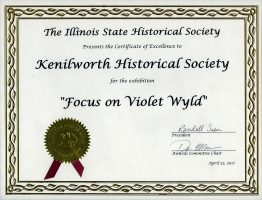
Awarded by the Illinois State Historical Society for our exhibit focusing on key resident and niece of George Maher, Violet Wyld.
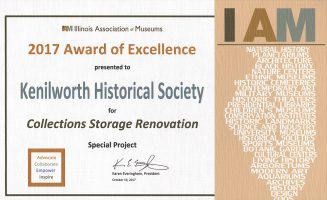
Awarded by the Illinois Association of Museums for our interior renovation work which improved our capabilities to safeguard our collections.
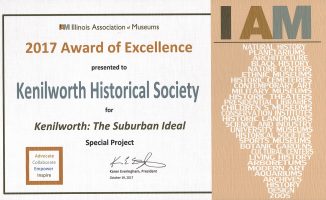
Awarded by the Illinois Association of Museums for the production of our historical documentary, directed by John Newcombe.
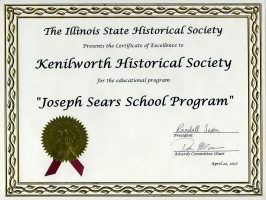
Awarded by the Illinois State Historical Society for our educational program with the Joseph Sears School.
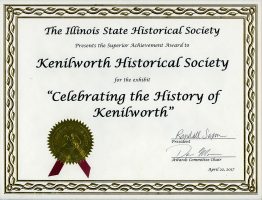
Awarded by the Illinois State Historical Society for our exhibit Celebrating the History of Kenilworth.
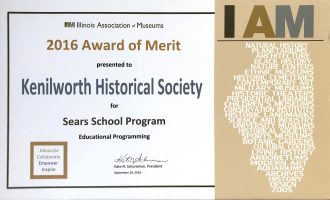
Awarded by the Illinois Association of Museums for our educational program with the Joseph Sears School.
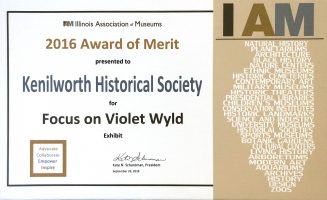
Awarded by the Illinois Association of Museums for our exhibit focusing on key resident and niece of George Maher, Violet Wyld.
Awarded by the Illinois Association of Museums for our exhibit titled The Suburban Ideal: Architecture and Neighborhoods.
Awarded by the Illinois Association of Museums for our exhibit View from the Path: Jens Jensen in Kenilworth.
Awarded by the Illinois Association of Museums for our educational program with the Joseph Sears School.

Awarded by the Illinois State Historical Society for our exhibit Celebrating the Century: The Joseph Sears School Centennial Exhibition.
Board of Directors
*Past Presidents
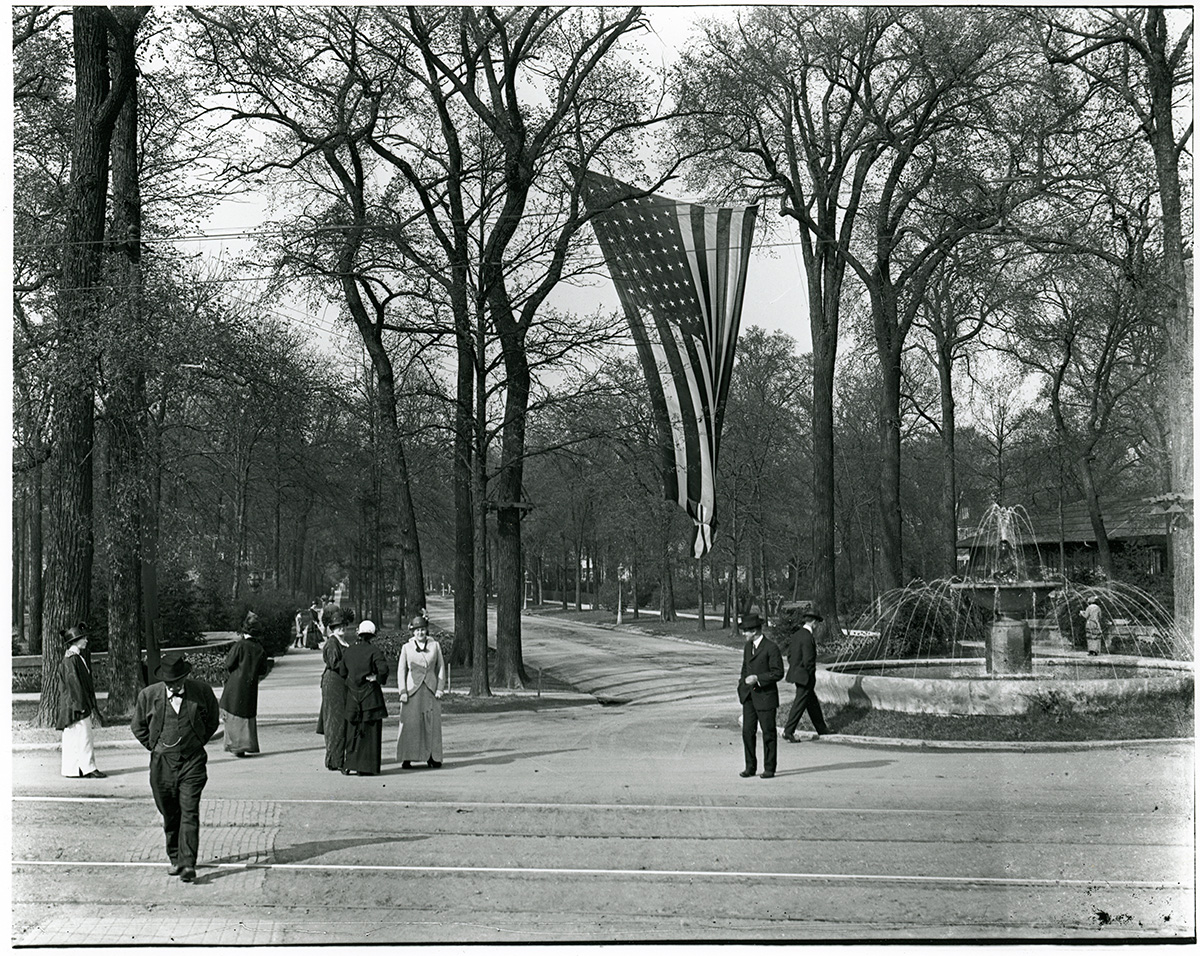
Kenilworth Fountain, c. 1910, KHS
Our main entrance is along Kenilworth Avenue, but handicap accessibility is available via the Village of Kenilworth entrance on Richmond Road. You can visit us from 9:00-5:00PM on Tuesdays and Thursdays.
Explore our online News and Exhibits & Collections.
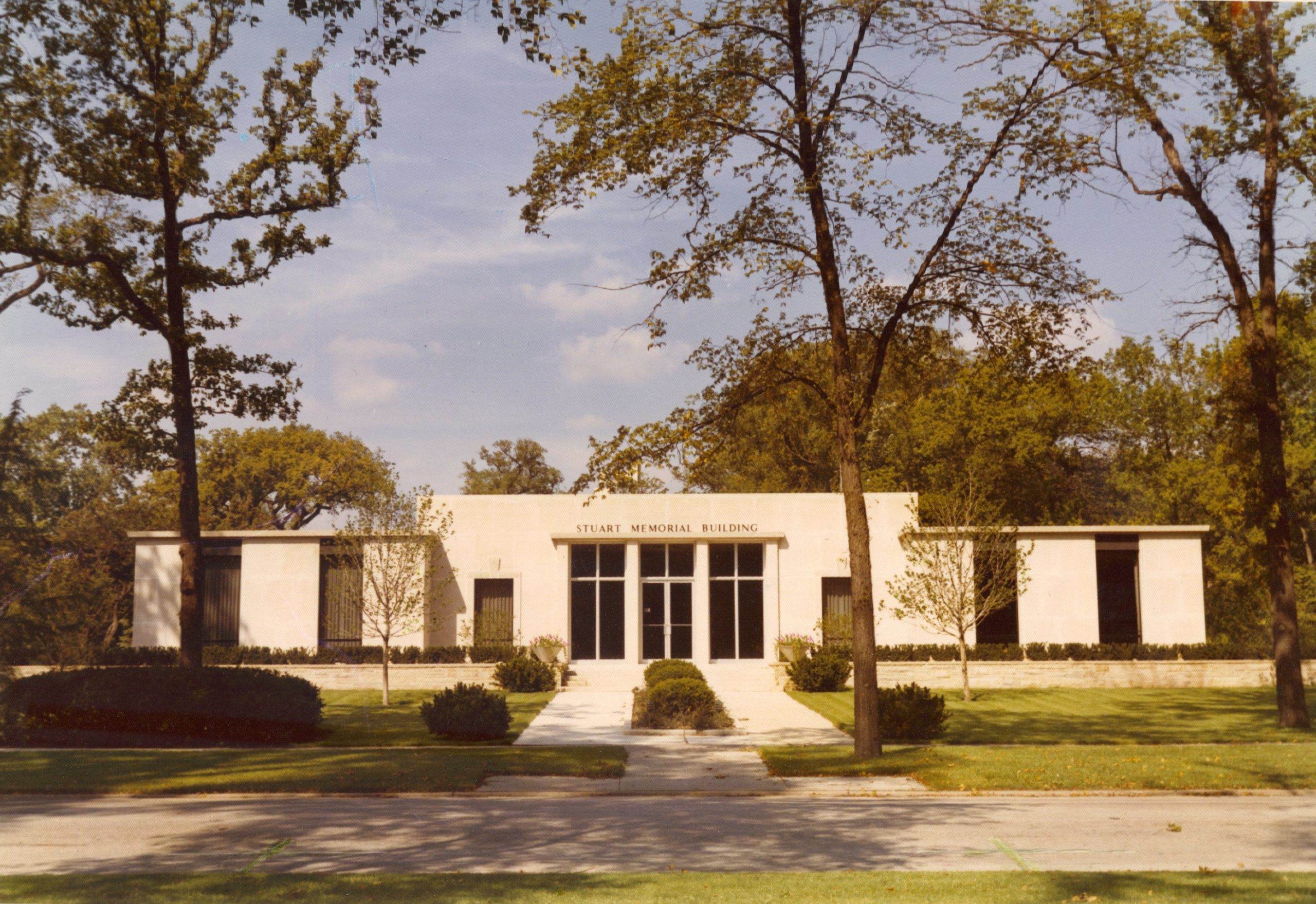
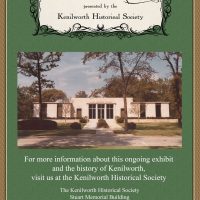
Our archives and exhibit space is located in the Stuart Memorial Building, designed by architect Philip Maher and completed on March 23, 1972. If KHS would build a permanent residence, it was promised to receive a large donation from the estate of Harold Leonard Stuart. President at the time Dr. Schildberg rushed to accumulate funds and plans for the new building. With the help from the Village offices and Park District, the Historical Society acquired the whole block from Cumnor, Kenilworth, and Richmond and soon after a grant from the bank for $550,000 to begin construction.

The Kenilworth Historical Society is across the street from the Kenilworth Metra station on the Union Pacific North (UP-N) to Kenosha line.
The station was designed by architect Franklin Burnham in 1891.
Visiting the Museum
Accessible parking is available adjacent to our main entrance along 419 Richmond Road with access to a ramp and button operated doors. For further assistance with navigating the building give us a call ahead of time.
Restrooms
Restrooms are available on the west side of the building complete with wide stalls and grab bars.
Service Animals
Service Animals are welcome to the museum in accordance to the ADA guidelines, unless otherwise permitted.
First Aid
We have first aid kits available on site if needed. We share the building with the Police Department who are all CPR certified.
Exhibit
All of our exhibits are labeled with larger font sizes and ADA compliant.

The company undertook all marketing activities, publicizing the community’s many attractive features through brochures, maps, and newspaper ads, as well as direct personal sales. Prospects were provided transportation from the city and greeted with a reception. Visitors were also offered overnight accommodations. In 1891, Sears invited about 20 of his personal friends, prominent bankers and Chicago businessmen to a picnic luncheon on Kenilworth’s lake shore. Lots were offered at $60 a foot; significantly above the $15 a foot for similarly located property nearby. Some laughed, but the property did sell within 12 months.
Joseph Sears possessed definite ideas about how a village should be planned. Streets were designed to maximize the availability of sunlight in each home, utilities were placed underground, no alleys or fences were permitted, construction standards were high, and there were large lots and paved streets. To maintain the country atmosphere, the plan required large lots and setbacks, tree plantings along roadways, and generous park lands. Mr. Sears donated much of his own property to achieve this goal. This planned community attracted widespread attention and was visited by many noted architects attending the 1893 Columbian Exposition in Chicago. Noted architect Franklin Burnham joined The Kenilworth Company and designed Kenilworth Station and Kenilworth Union Church. Burnham also designed several homes for company members to display for potential residents.
By February 4, 1896, the village reached the required 300 residents and was incorporated, with an elected board assuming municipal functions from Joseph Sears. The Kenilworth Company continued their sales activities until 1904, at which time Sears acquired the existing stock and became the sole owner of the remaining property. From the original purchase developed by Joseph Sears, Kenilworth expanded to its current size of 0.6 of a square mile through a series of annexations. As of the 2010 census, Kenilworth had a population of 2,513.
Bring your hard hats! Demolition work for our upstairs renovation has begun. But don’t despair, our collections will remain open for research during the construction!
Board member & Treasurer, Tim Miller, and Collections Manager, Jeremy Murray, accepted Awards of Excellence at the Illinois Association of Museums conference in Mt. Vernon, IL! KHS was recognized for the documentary, Kenilworth: The Suburban Ideal, and the renovation of the collection and curatorial spaces on KHS’s lower level. 10/21/2017

The Kenilworth Historical Society was founded through community action and continues to serve Kenilworth through the active support of community members. Our mission is supported everyday by volunteers and board members who help in the operation of KHS. We would not be here if it were not for the support of donors who contribute not only time, talent and financial support, but the objects which we preserve and care for in our collection.
If you would like to get involved at KHS explore the opportunities on how you can help support us:
Artist’s map of Kenilworth c. 1896, KHS
The Kenilworth Historical Society archive holds extensive material on the founding and growth of Kenilworth and its key institutions. These materials provide incredible insight to the daily operations of the village and the community who calls it home.
We have an extensive archives and photograph collection for in-depth research into the following topics:
Please call 847-251-2565 ahead of time to schedule a research visit.

The first organized public exhibit of the Kenilworth Historical Society was held in 1961 in the Kenilworth Assembly Hall. The exhibit showcased many of the Kenilworth and Sears family artifacts collected since the Historical Society’s founding. The exhibit also spurred increased efforts to secure a permanent home for the Kenilworth Historical Society and its collection.
The hope of a permanent home was secured when in 1970 Historical Society President, Dr. Harold S. Schildberg, was approached by Harriet and Elisabeth Stuart, who wished to donate money if the Historical Society could gather the plans for a permanent housing. The Stuart sisters offered money from the estate of their late brother, Harold Leonard Stuart. Construction of what became known as the Stuart Memorial Building began March 1, 1971 and was completed on March 23, 1972. Since its completion, the Stuart Memorial Building has been home to both the Kenilworth Historical Society and the offices of the Village of Kenilworth.

The founding of the Kenilworth Historical Society was first proposed by Dr. Rufus Stolp at a gathering in 1921 at the home of Victor and Louisa Sanborn. Charter members included: Mary and Dr. Rufus Stolp, Victor and Louisa Sanborn, Warren and Christine Pease, and Edward and Nellie Parmalee, with Dr. Stolp becoming the first president of the Kenilworth Historical Society.
The first meeting was held on October 30, 1922 at the residence of Mrs. Helen Sears. Eighty-six Kenilworth residents were in attendance at the first meeting where presentations were given by both Helen Sears and Dr. Charles Smith, first secretary of the Kenilworth Company.
Through the years, Kenilworth Historical Society meetings and programs were held in the Kenilworth Assembly Hall. Artifacts, records, and photographs were collected forming the base of the Kenilworth Historical Society’s collection. As the Historical Society had no home of its own this fledgling, yet growing, collection was stored in attics, basements, garages, and spare rooms of Society members.
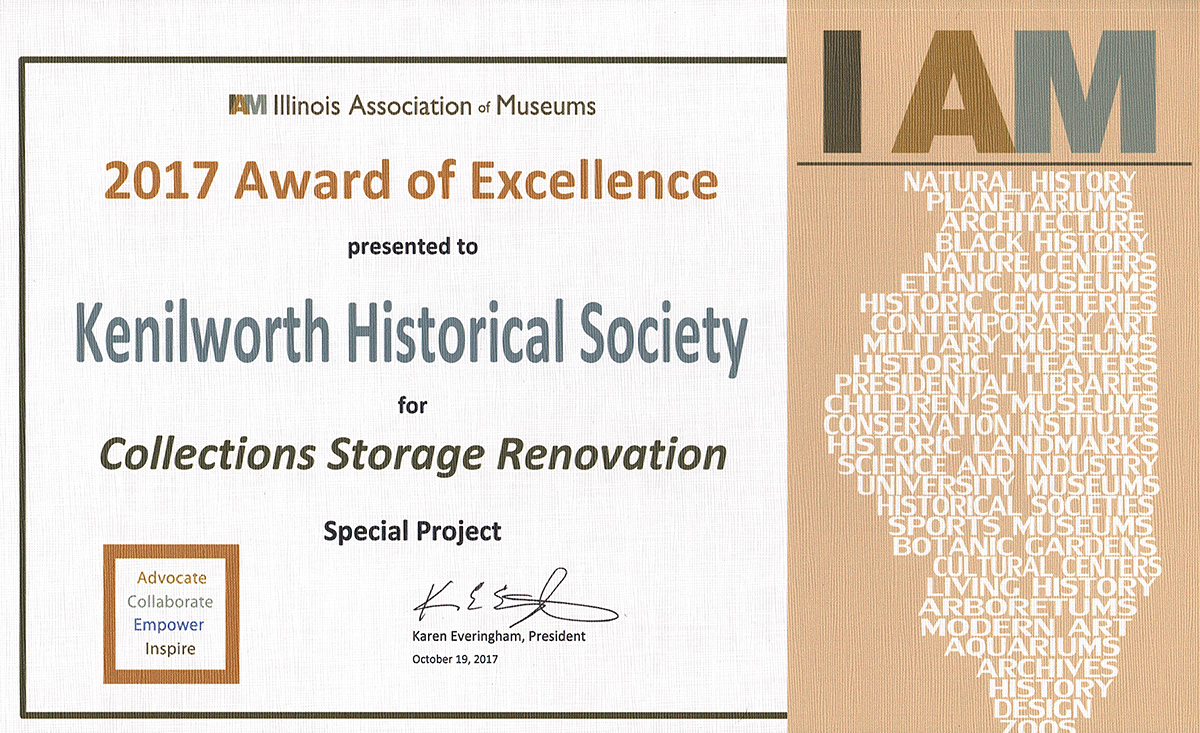
Awarded by the Illinois Association of Museums for our interior renovation work which improved our capabilities to safeguard our collections.
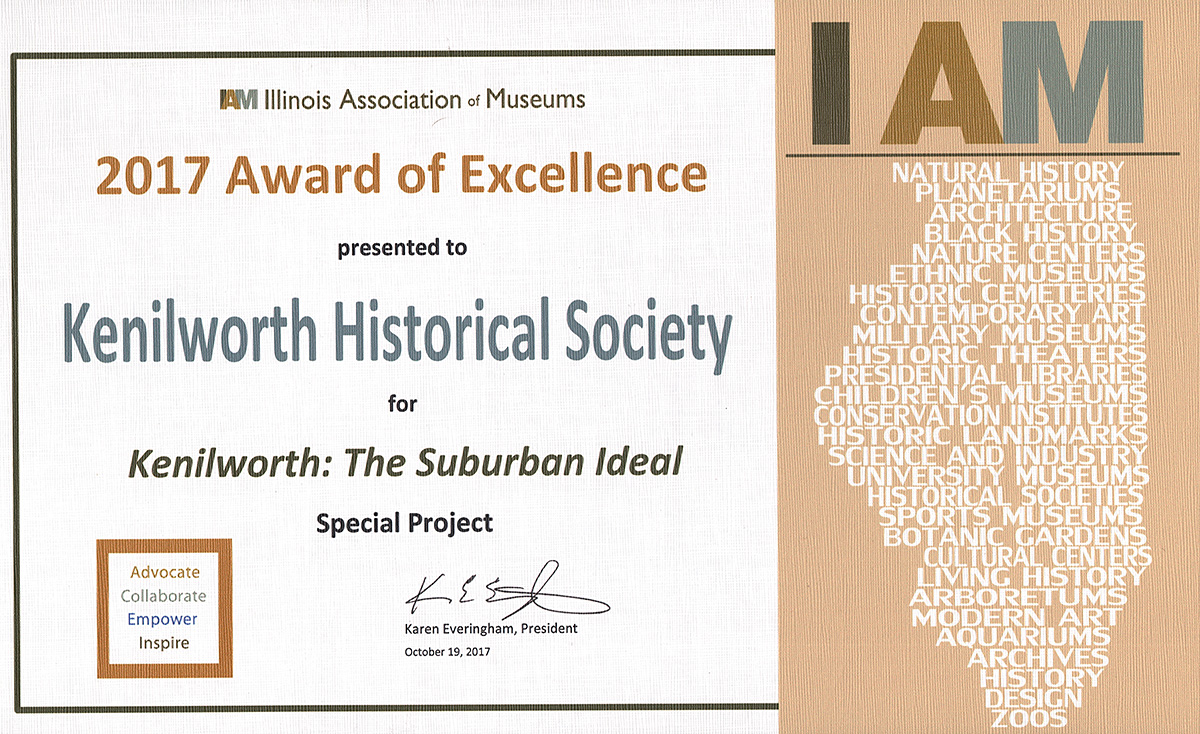
Awarded by the Illinois Association of Museums for the production of our historical documentary, directed by John Newcombe.
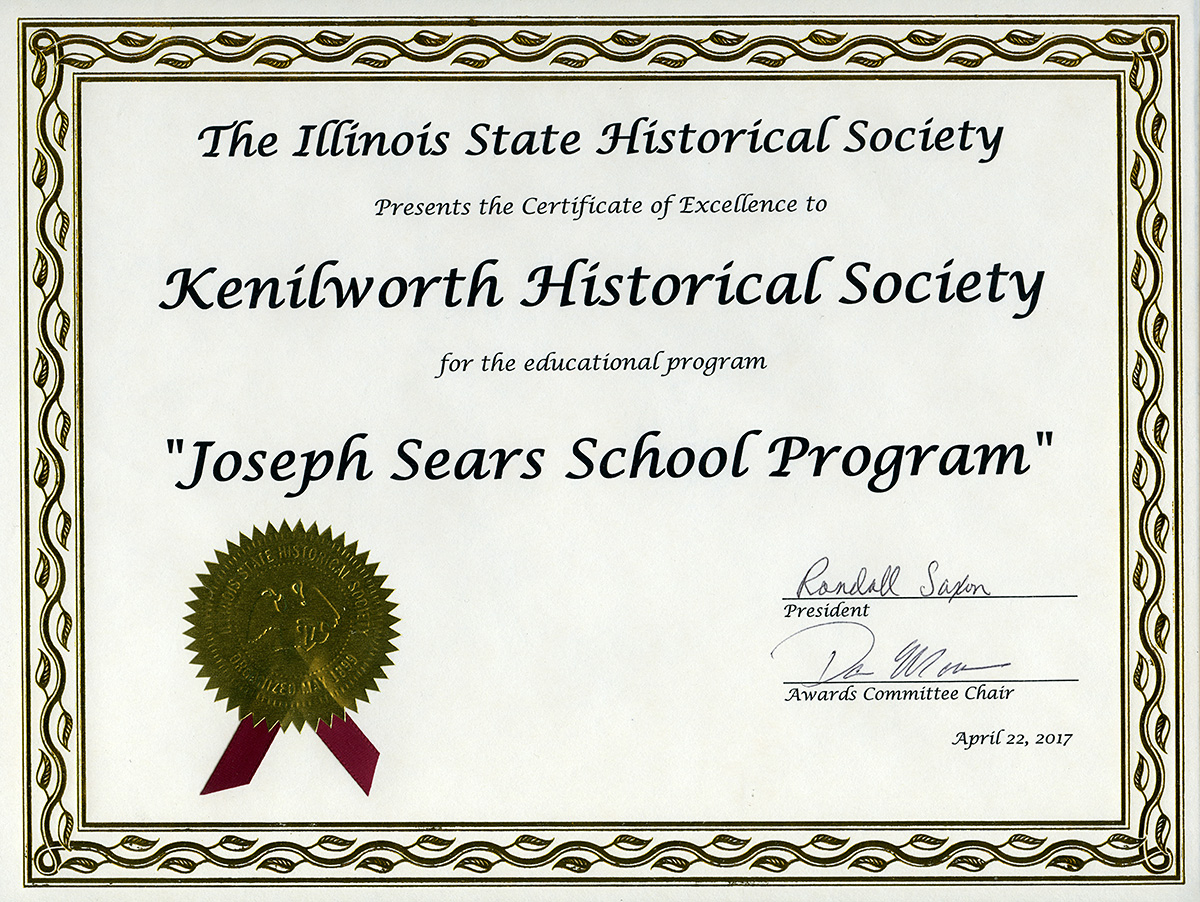
Awarded by the Illinois State Historical Society for our educational program with the Joseph Sears School.
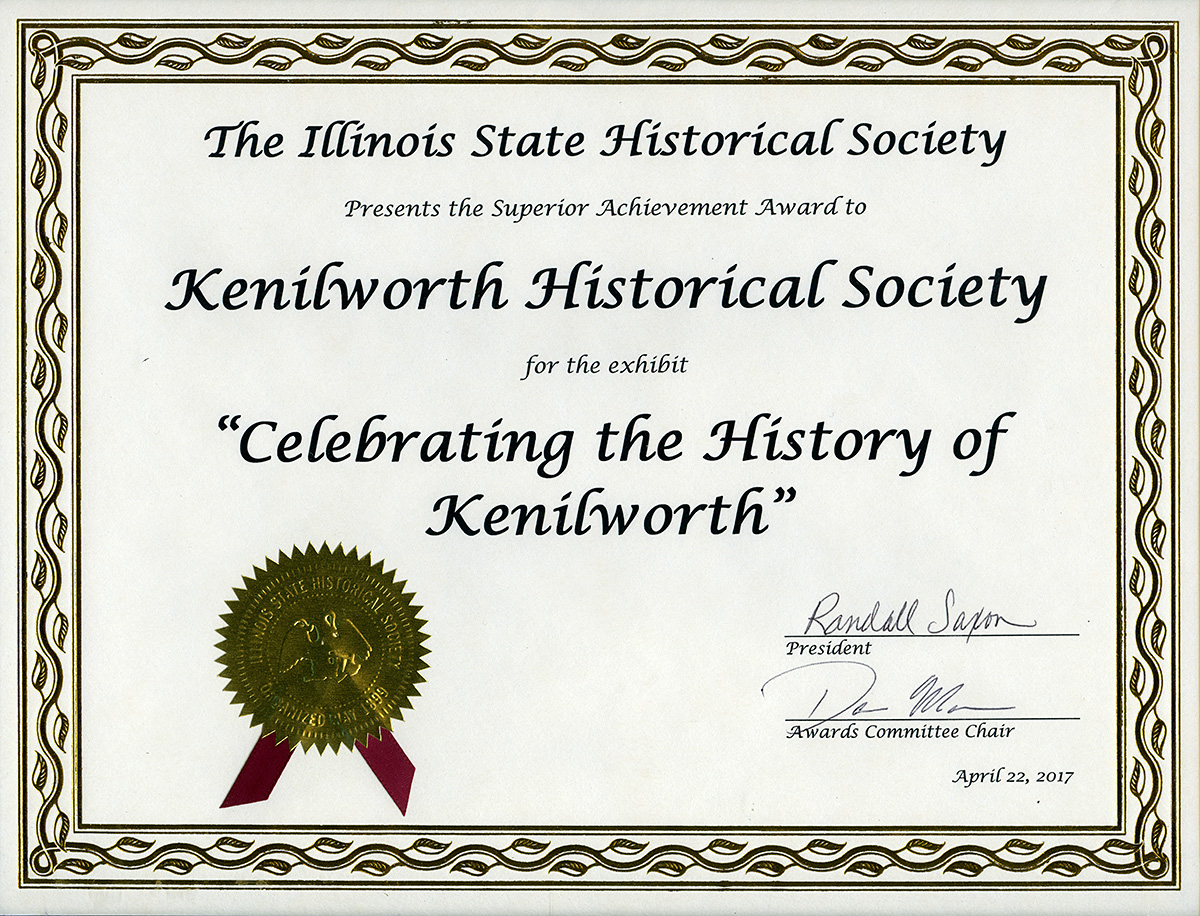
Awarded by the Illinois State Historical Society for our exhibit Celebrating the History of Kenilworth.
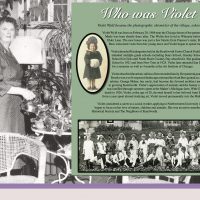
Her legacy to our village is her collection of remarkable photographs which captured the local events, homes, pets and families of Kenilworth. Focus on Violet Wyld uncovered the many dimensions of her eventful life through her own words and her extraordinary photographs.
When Violet wasn’t with her camera, she was playing with animals or walking through one of Kenilworth’s parks. Violet had an extra appreciation of animals and the beauty of natural surroundings, which was instilled through summers spent at her uncle, George Maher’s, Michigan farm.
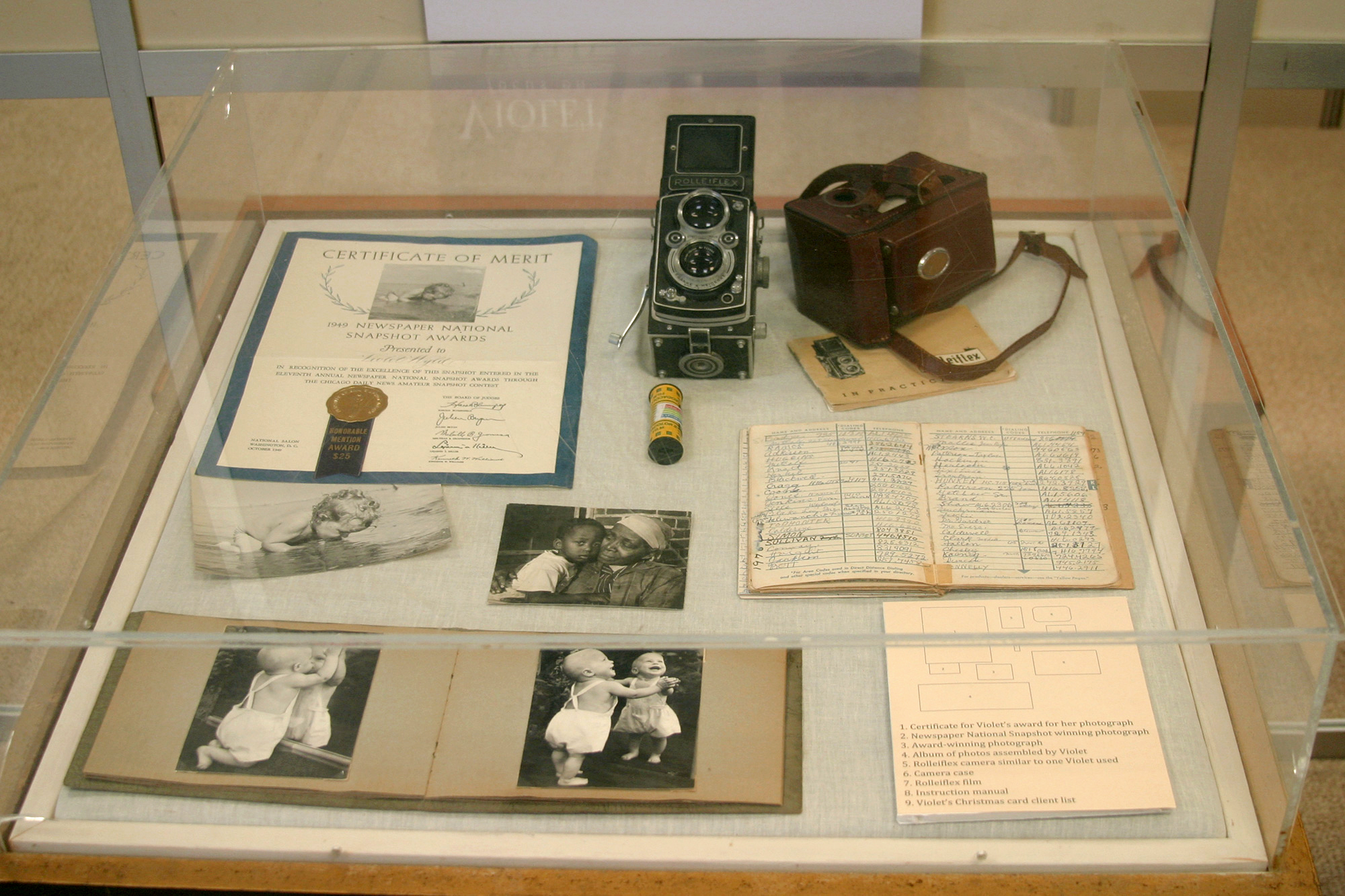
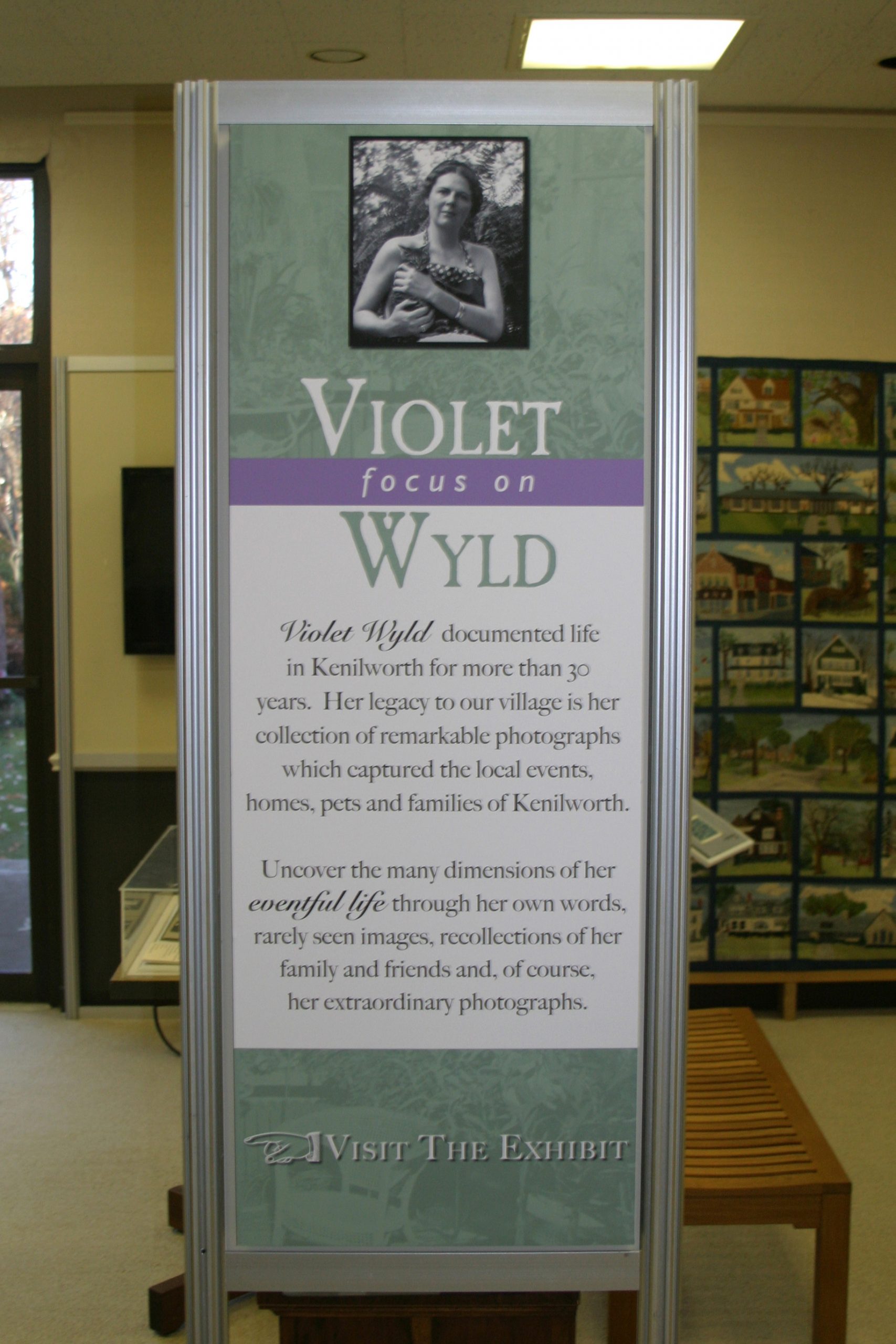
Focus on Violet Wylde was displayed from Oct 2016 – 2017
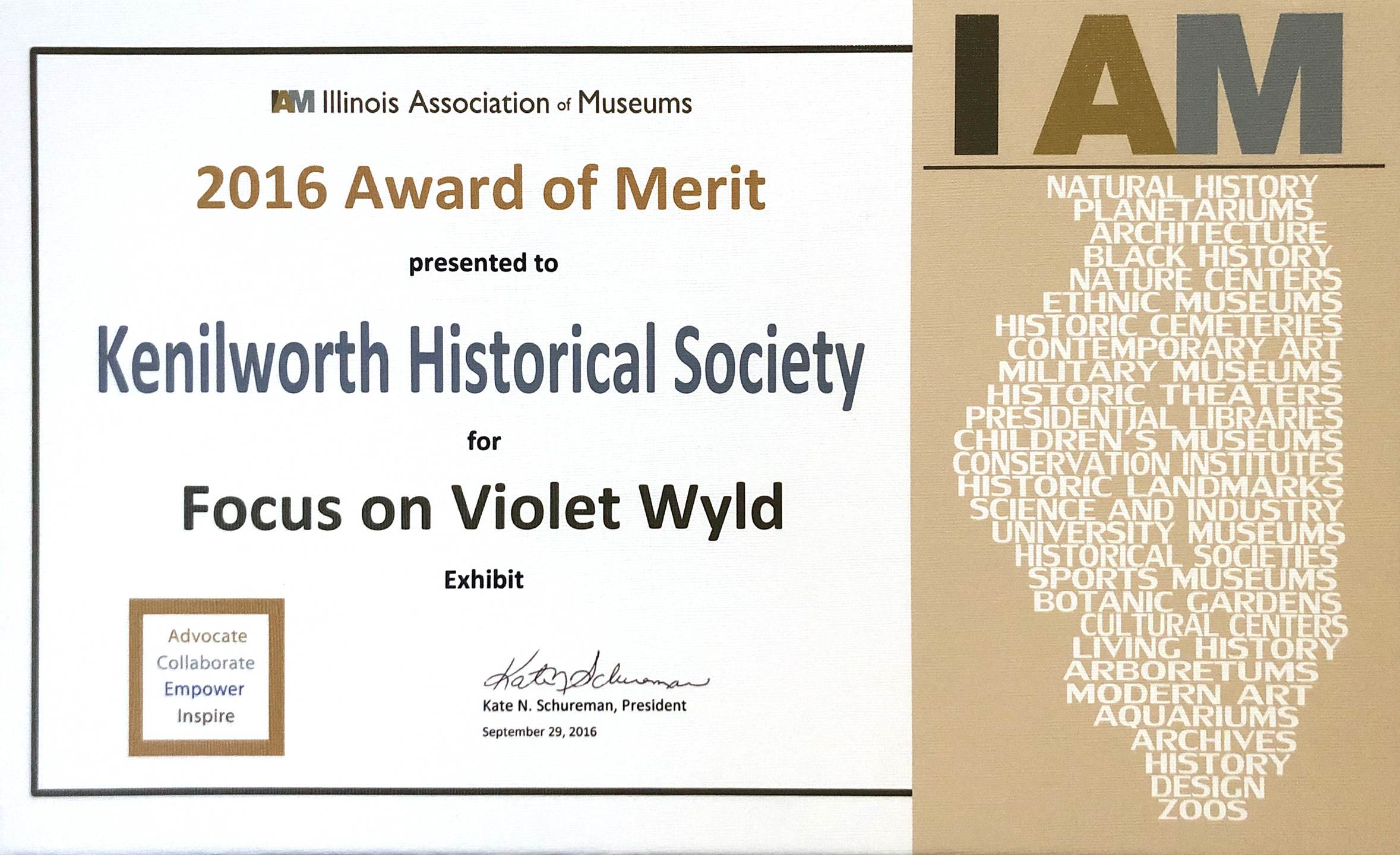
Awarded by the Illinois Association of Museums for our exhibit focusing on key resident and niece of George Maher, Violet Wyld.
How Can I Help You: Business and Commerce in Kenilworth exhibit, c. 2017, KHS
View a selection of the images, brochures, special features, and virtual tours of shows no longer on view at the Kenilworth Historical Society.
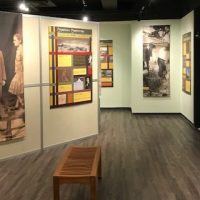
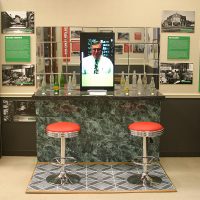
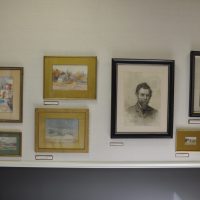
A look at the collections storage, c. 2019, KHS
Explore the variety of past exhibitions and learn how to donate to our collection of artifacts, photographs and documents. (Images in this section are published for educational use under the umbrella of the Fair Use doctrine.)
“History and Development of Kenilworth” is a permanent exhibition at the Kenilworth Historical Society that was opened in 2021. This exhibition serves as a comprehensive introduction to the village’s rich history. In addition to detailed text panels with historical images, visitors will find interactive touchscreen displays for a hands-on approach to exploring local history.
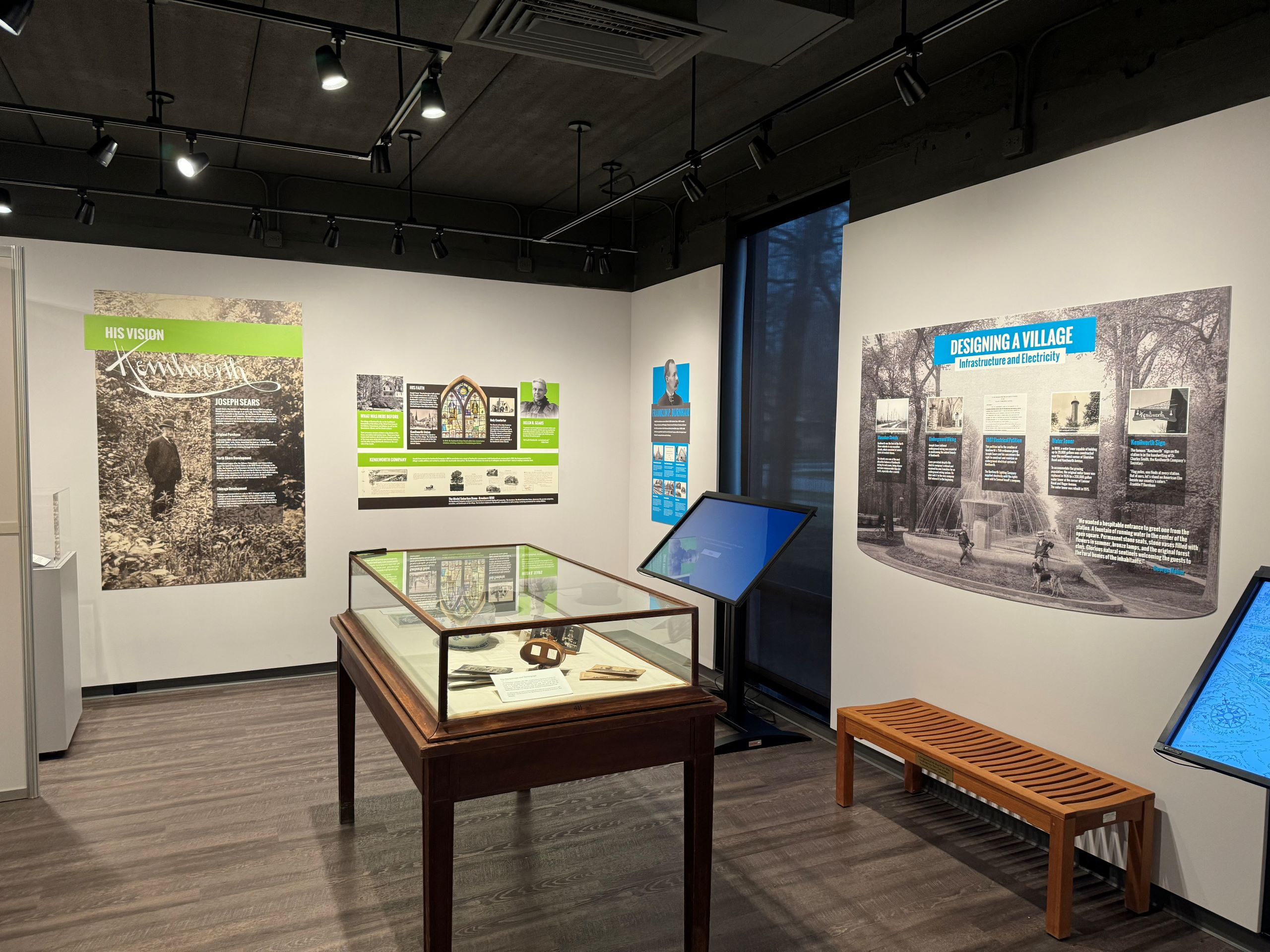
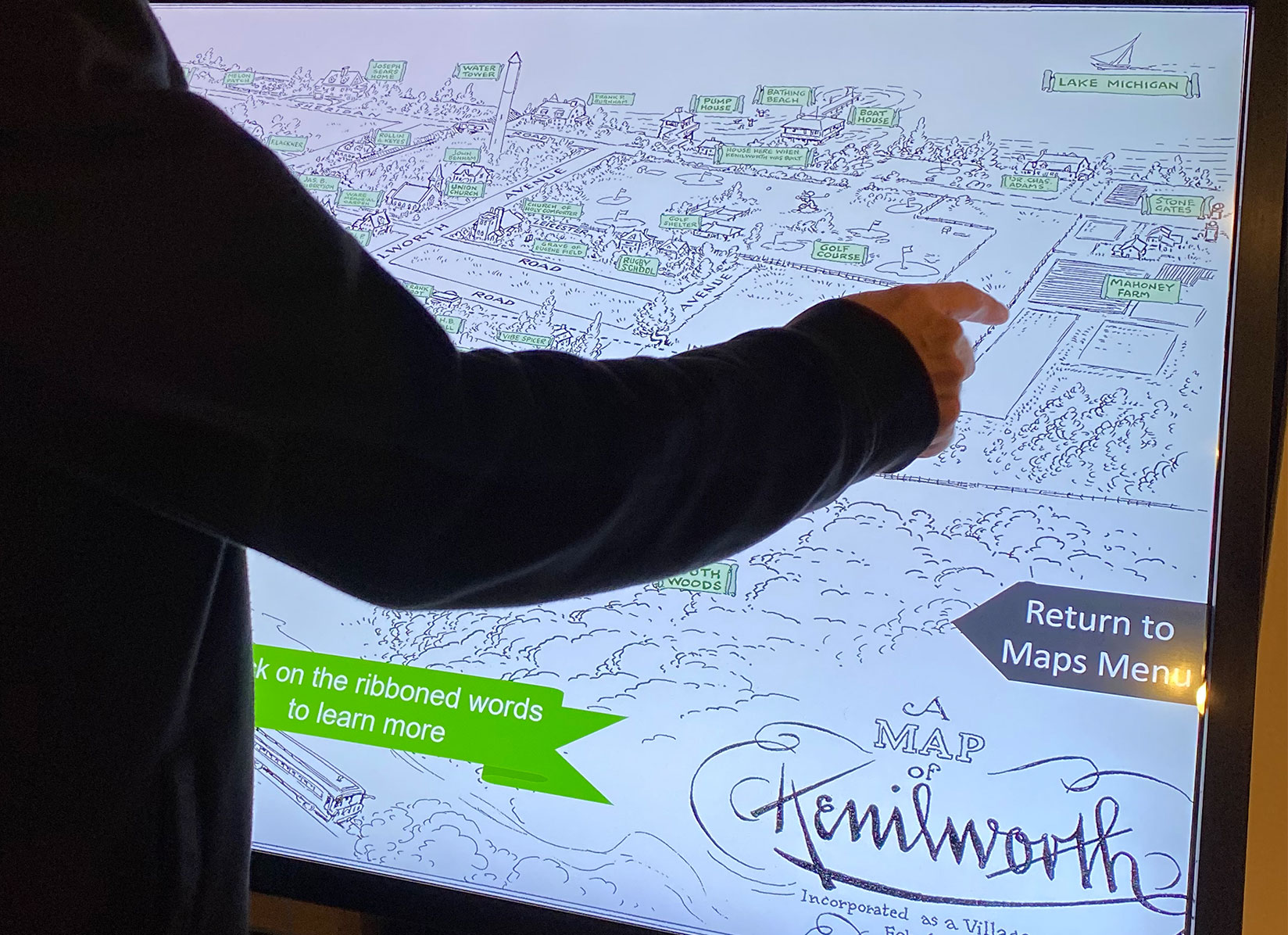
Kenilworth has always been shaped by water. When the village was established, Lake
Michigan defined its eastern boundary, providing a water source as well as opportunities for recreation. At the same time, water posed ongoing challenges, from flooding to the need for reliable infrastructure as the community grew.
Over time, Kenilworth responded with engineered solutions, evolving water systems, and lakefront improvements. Deep Dive: A History of Kenilworth’s Water Infrastructure and Lakefront traces how water has influenced the village’s development, from the Kenilworth Company’s careful planning to continued efforts to manage stormwater and preserve the shoreline. Historic maps, photographs, and artifacts from the decommissioned water plant will be featured.

A look at the collections storage, c. 2019, KHS
Primary focus of the materials collected are relevant to the growth and development of the village and the organizations and the individuals associated with Kenilworth, IL.
Kenilworth historical society collects objects with historic, cultural or aesthetic value or having historical significance to people, events and organizations of Kenilworth, IL. Collecting is an on-going process and the curatorial staff continues to research and actively seek artifacts and archival material that are expected to have future historic significance.
There are 3 primary collection categories – Library, General Collections (Art, Artifact, Textiles and Photographs) and Archives.
Our collection was started and has grown since 1922 almost exclusively through the donation of artifacts, documents and photographs from the Kenilworth community. If you have an item you wish to donate, or even if you wish to know more about the item before deciding whether to donate, there are several steps to follow:
1) Contact KHS
Before you mail or drop off the item you wish to donate, please contact our Collections Manager via phone, email or in person to discuss whether we are interested in accepting the item for the collection. The item you wish to donate may already be represented in our collection or may not fit within the criteria of our collection policy. By scheduling a meeting with our Collections Manager we can best establish the significance of the item and whether it is a fitting addition to our collection.
KHS will not accept accept abandoned and/or undocumented items in person or through the mail and may dispose of such items pursuant to (765 ILCS 1033/) Museum Disposition of Property Act.
Email: khscollections@gmail.com
Phone: (847) 251-2565
2) Provide sufficient information
In order for KHS staff to have the best possible understanding of an items relation to Kenilworth it is necessary for donors to provide as much information on the item as possible. This information helps KHS staff to determine the significance of the donation, the donation’s ties to Kenilworth, and a clear succession of title for the item. In order to collect this information donors are asked to fill out this Receipt of Items form prior to or upon dropping off or mailing the items.
3) Complete Paperwork
Once it has been determined an item fits the KHS collection policy and will be accepted into the KHS collection a Deed of Gift will be prepared for the donation. The Deed of Gift officially transfers title of the donation to KHS. Donors will be provided with a copy of the Deed of Gift, which includes a description of the item/s and KHS collection Object ID reference number/s
The Kenilworth Historical Society reserves the right to refuse donations to the collection. In the case of refusal, the donor is responsible for retrieving the objects within two weeks of notification. If the donor is unable or unwilling to retrieve the items the Kenilworth Historical Society may dispose of them as they see fit.
300 Abbotsford, 1895
307 Abbotsford, c. 1900
314 Abbotsford, 1892
315 Abbotsford, 1908
330 Abbotsford, 1909
336 Abbotsford, 1891
337 Abbotsford, 1916
417 Abbotsford, 1909
422 Abbotsford, 1916
423 Abbotsford, 1891
430 Abbotsford, 1895
431 Abbotsford, c. 1900
515 Abbotsford, 1895
520 Abbotsford, c. 1900
531 Abbotsford, 1921
610 Abbotsford, 1908
611 Abbotsford, 1913
615 Abbotsford, pre-1914
616 Abbotsford, pre-1914
620 Abbotsford, pre-1914
623 Abbotsford, pre-1914
624 Abbotsford, 1909
627 Abbotsford, 1917
628 Abbotsford, pre-1914
632 Abbotsford, 1910
637 Abbotsford, c. 1905
644 Abbotsford Road c. 1926
119 Abingdon, 1926
120 Abingdon, 1924
132 Abingdon, 1924
138 Abingdon, 1922
139 Abingdon, 1924
142 Abingdon, 1925
150 Abingdon, 1923
151 Abingdon, 1925
156 Abingdon, 1924
159 Abingdon, 1925
162 Abingdon, 1922
163 Abingdon, 1923
166 Abingdon, 1926
202 Abingdon, 1924
205 Abingdon, 1926
210 Abingdon, 1926
211 Abingdon, 1926